Modjarrad Lina, Marlow Nicole, Bollinger Avery, Zhu Yenan
Department of Health Services Research, Management, and Policy, College of Public Health and Health Professions, University of Florida, 1225 Center Dr, Gainesville, FL, 32610, USA.
Department of Social and Behavioral Sciences, College of Public Health and Health Professions, University of Florida, 1225 Center Dr, Gainesville, FL, 32610, USA.
J Eat Disord. 2025 Jul 29;13(1):159. doi: 10.1186/s40337-025-01355-2.
Disordered eating behaviors (DEBs) represent a significant public health issue, with childhood maltreatment emerging as a potential contributing factor. However, the longitudinal impact of maltreatment on the progression of disordered eating behaviors from adolescence to adulthood remains inadequately understood. This study aims to explore how childhood maltreatment influences the trajectory of disordered eating behaviors, focusing on potential moderating factors such as sociodemographic variables, race, and sex.
Data from Waves I-III of Add Health (ages 11-26) were used to assess DEB trajectories, with retrospective childhood maltreatment data collected in Wave IV. Repeated measures mixed-effects models accounted for intra-individual variability, adjusting for relevant covariates. Interaction effects between maltreatment subtypes and sociodemographic covariates (sex, race/ethnicity, income) were analyzed to examine how these intersections influenced DEB trajectories.
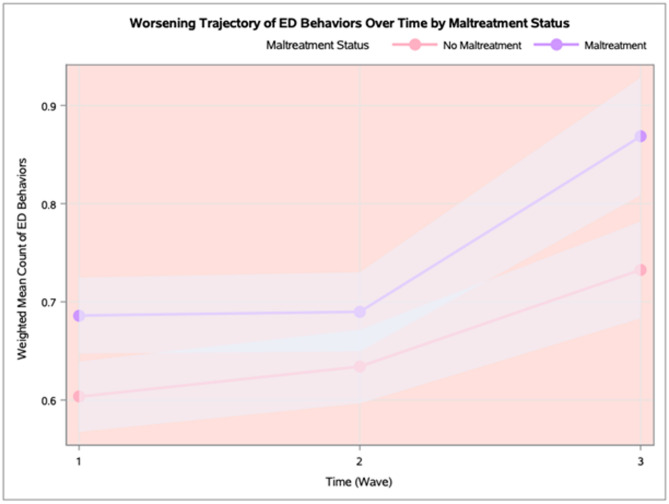
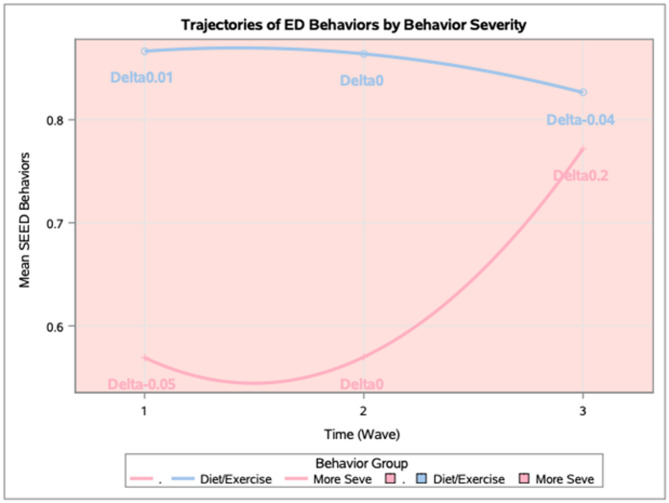
Among the 15,363,384 participants, 49.2% experienced childhood maltreatment. Adjusted models indicated significant increases in DEBs over time, particularly between Waves II and III (β = 19.9, p < 0.001). Although physical abuse (β = 1.88, p = 0.1330), verbal abuse (β = -0.67, p = 0.4529), and sexual abuse by a parent (β = 1.59, p = 0.4204) were not significant predictors of worsening behaviors, stratified analyses revealed that low-income individuals exposed to non-familial sexual abuse demonstrated the steepest worsening of DEBs (β = 26.5, p = 0.0048). Interaction effects revealed that Asian or Pacific Islander participants experiencing verbal abuse, and low-income individuals exposed to non-familial sexual abuse demonstrated pronounced worsening of DEBs. We observed significant sex differences: males exhibited higher levels of worsening behaviors over time (β = -10.8, p < 0.0001).
Our findings suggest that sociodemographic characteristics (sex, race, income) may moderate the persistence of DEBs, underscoring the need for trauma-informed and tailored interventions. Addressing childhood adversity through public health, policy, and clinical efforts can help support those at highest risk. Future research should examine these trajectories beyond early adulthood and explore protective factors that may buffer against long-term DEB risk.
饮食失调行为是一个重大的公共卫生问题,童年期虐待是一个潜在的促成因素。然而,虐待对饮食失调行为从青春期到成年期发展的纵向影响仍未得到充分理解。本研究旨在探讨童年期虐待如何影响饮食失调行为的轨迹,重点关注社会人口统计学变量、种族和性别等潜在调节因素。
使用青少年健康纵向研究(Add Health)第一至三轮(年龄11 - 26岁)的数据评估饮食失调行为轨迹,第四轮收集童年期虐待的回顾性数据。重复测量混合效应模型考虑个体内变异性,并对相关协变量进行调整。分析虐待亚型与社会人口统计学协变量(性别、种族/族裔、收入)之间的交互作用,以研究这些交叉因素如何影响饮食失调行为轨迹。
在15363384名参与者中,49.2%经历过童年期虐待。调整后的模型表明,饮食失调行为随时间显著增加,特别是在第二轮和第三轮之间(β = 19.9,p < 0.001)。虽然身体虐待(β = 1.88,p = 0.1330)、言语虐待(β = -0.67,p = 0.4529)和来自父母的性虐待(β = 1.59,p = 0.4204)不是行为恶化的显著预测因素,但分层分析显示,遭受非家庭性虐待的低收入个体饮食失调行为恶化最为严重(β = 26.5,p = 0.0048)。交互作用分析显示,遭受言语虐待的亚裔或太平洋岛民参与者,以及遭受非家庭性虐待的低收入个体饮食失调行为显著恶化。我们观察到显著的性别差异:随着时间推移,男性的行为恶化程度更高(β = -10.8,p < 0.0001)。
我们的研究结果表明,社会人口统计学特征(性别、种族、收入)可能会调节饮食失调行为的持续性,强调了需要采用考虑创伤因素的针对性干预措施。通过公共卫生、政策和临床努力应对童年逆境,有助于支持那些风险最高的人群。未来的研究应在成年早期之后继续研究这些轨迹,并探索可能缓冲长期饮食失调行为风险的保护因素。