Yu Linlin, Shi Shuang, Shen Li, Cheng Tan, Ding Guodong, Jing Xiaoping
Department of Traditional Chinese Medicine, Shanghai Children's Hospital, School of medicine, Shanghai Jiao Tong University, Shanghai, China.
Department of Respiratory Medicine, Shanghai Children's Hospital, School of Medicine, Shanghai Jiao Tong University, Shanghai, China.
BMC Public Health. 2025 Aug 2;25(1):2619. doi: 10.1186/s12889-025-23876-w.
Humans are widely exposed to mixtures of environmental perchlorate, nitrate, and thiocyanate. However, the associations of perchlorate, nitrate, and thiocyanate with pulmonary function in children were unclear.
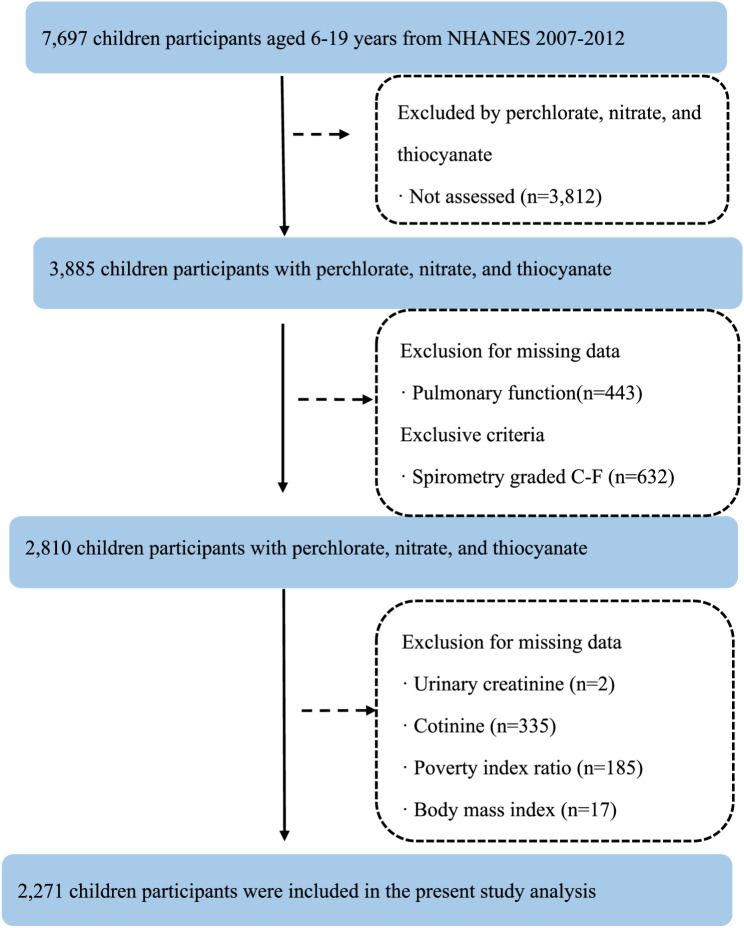
To investigate the associations of urinary perchlorate, nitrate, and thiocyanate concentrations with pulmonary function in children, a total of 2,271 children and adolescents aged 6-19 years with complete data on perchlorate, nitrate, and thiocyanate and pulmonary function were analyzed from the U.S. NHANES 2007-2012. Exposure to perchlorate, nitrate, and thiocyanate was estimated by measuring urinary concentration, and pulmonary function was assessed by spirometry. Linear regression and generalized linear models were performed to estimate the associations of perchlorate, nitrate, and thiocyanate concentrations with pulmonary function measures. Stratified subgroup analyses were performed to examine whether age (6-12 and 13-19 years) and sex differences modified these associations.
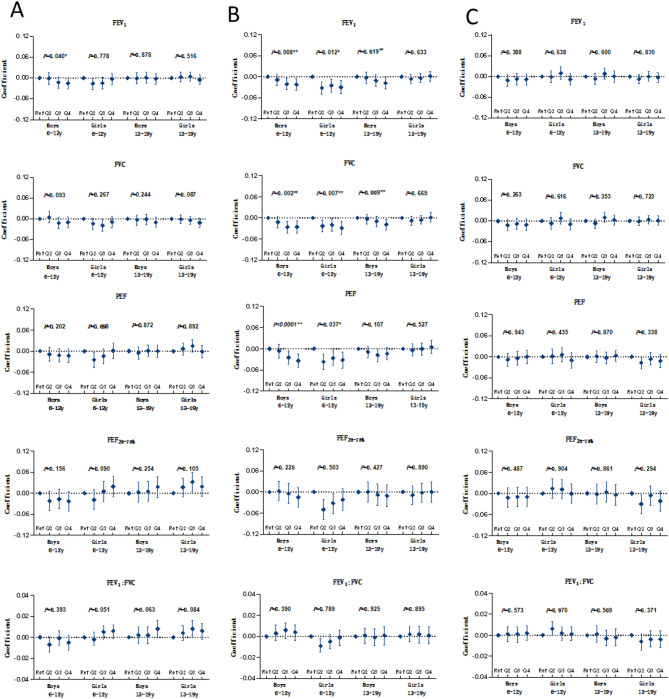
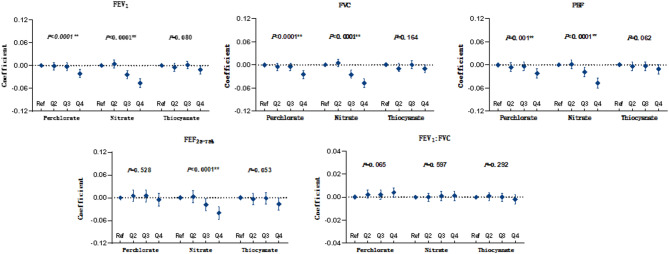
In the overall population, concentrations of perchlorate and nitrate, except for thiocyanate, were associated with a modest decrease in pulmonary function. After stratification by age and sex, those negative associations were more pronounced among the children aged 6-12 years. In children aged 6-12 years, perchlorate concentration was negatively associated with FEV1 (p-trend = 0.04) among boys. In children aged 6-12 years, nitrate concentration was negatively associated with FEV1, FVC, and PEF, respectively (all p-trends < 0.05), in both boys and girls.
Our study suggested that exposures to perchlorate, nitrate, except for thiocyanate were associated with impaired pulmonary function in children and adolescents aged 6-19 years, and those associations were more pronounced among children aged 6-12 years. Further replications of the associations in a large prospective cohort study are warranted.
人类广泛接触环境中的高氯酸盐、硝酸盐和硫氰酸盐混合物。然而,高氯酸盐、硝酸盐和硫氰酸盐与儿童肺功能之间的关联尚不清楚。
为了研究尿中高氯酸盐、硝酸盐和硫氰酸盐浓度与儿童肺功能之间的关联,对来自美国2007 - 2012年国家健康与营养检查调查(NHANES)的2271名6 - 19岁儿童和青少年进行了分析,这些儿童和青少年具有关于高氯酸盐、硝酸盐、硫氰酸盐和肺功能的完整数据。通过测量尿浓度来估计高氯酸盐、硝酸盐和硫氰酸盐的暴露情况,并通过肺活量测定法评估肺功能。采用线性回归和广义线性模型来估计高氯酸盐、硝酸盐和硫氰酸盐浓度与肺功能指标之间的关联。进行分层亚组分析以检验年龄(6 - 12岁和13 - 19岁)和性别差异是否会改变这些关联。
在总体人群中,除硫氰酸盐外,高氯酸盐和硝酸盐浓度与肺功能适度下降有关。按年龄和性别分层后,这些负相关在6 - 12岁儿童中更为明显。在6 - 12岁儿童中,男孩的高氯酸盐浓度与第一秒用力呼气容积(FEV1)呈负相关(p趋势 = 0.04)。在6 - 12岁儿童中,硝酸盐浓度在男孩和女孩中分别与FEV1、用力肺活量(FVC)和呼气峰值流速(PEF)呈负相关(所有p趋势 < 0.05)。
我们的研究表明,6 - 19岁儿童和青少年接触高氯酸盐、硝酸盐(除硫氰酸盐外)与肺功能受损有关,且这些关联在6 - 12岁儿童中更为明显。有必要在大型前瞻性队列研究中进一步重复验证这些关联。