Ke Xiaoying, Huang Min, Zheng Yingying, Chen Guohao
Department of Otolaryngology, The First Affiliated Hospital, Fujian Medical University, Fuzhou, 350005, China.
Department of Otolaryngology, National Regional Medical Center, BinhaiCampus of the First Affiliated Hospital, Fujian Medical University, Fuzhou, 350212, China.
Sci Rep. 2025 Aug 4;15(1):28347. doi: 10.1038/s41598-025-13687-9.
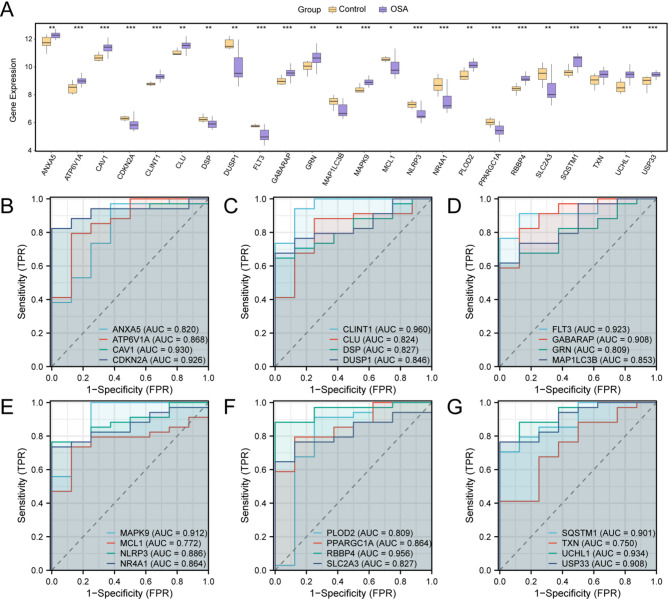
Obstructive sleep apnea (OSA) is a common sleep disorder characterized by recurrent upper airway obstructions, leading to substantial health burdens and socioeconomic costs. This study aimed to identify Hypoxia and Mitophagy-Related Differentially Expressed Genes (HMRDEGs) and evaluate their potential as biomarkers and therapeutic targets for OSA. Transcriptomic data from GSE135917 and GSE38792 in the GEO database were analyzed using the limma package to identify differentially expressed genes (DEGs), which were subsequently intersected with hypoxia- and mitophagy-related gene sets(HMRGs) curated from GeneCards and PubMed. A total of 24 HMRDEGs were identified, and four hub genes-NLRP3, MAPK9, RBBP4, and CLINT1-were used to construct a diagnostic model that demonstrated excellent discrimination (AUC = 0.982 in the training set and 0.812 in the validation set). Gene Ontology and KEGG analyses linked these genes to protein catabolism and autophagy pathways, while immune-cell infiltration profiling associated them with specific leukocyte subsets. Collectively, our findings underscore hypoxia-mitophagy crosstalk as a central mechanism in OSA and present a robust biomarker panel with therapeutic potential.
阻塞性睡眠呼吸暂停(OSA)是一种常见的睡眠障碍,其特征为反复出现上呼吸道阻塞,会导致巨大的健康负担和社会经济成本。本研究旨在识别缺氧和线粒体自噬相关差异表达基因(HMRDEGs),并评估它们作为OSA生物标志物和治疗靶点的潜力。使用limma软件包分析了基因表达综合数据库(GEO)中GSE135917和GSE38792的转录组数据,以识别差异表达基因(DEGs),随后将这些基因与从基因卡片(GeneCards)和医学期刊数据库(PubMed)中整理出的缺氧和线粒体自噬相关基因集(HMRGs)进行比对。共识别出24个HMRDEGs,并使用4个核心基因——NLRP3、MAPK9、RBBP4和CLINT1构建了一个诊断模型,该模型显示出出色的区分能力(训练集中的曲线下面积[AUC]=0.982,验证集中的AUC=0.812)。基因本体论(Gene Ontology)和京都基因与基因组百科全书(KEGG)分析将这些基因与蛋白质分解代谢和自噬途径联系起来,而免疫细胞浸润分析则将它们与特定的白细胞亚群联系起来。总的来说,我们的研究结果强调了缺氧-线粒体自噬串扰是OSA的核心机制,并提出了一个具有治疗潜力的强大生物标志物组合。