Yoshida Hisato, Nigo Masayuki, Hisada Kyoko, Tokunaga Takahiro, Matsuda Shinpei, Tsukamoto Hitoshi, Hosokawa Koji, Sakamaki Ippei, Yoshimura Hitoshi, Iwasaki Hiromichi
Department of Dentistry and Oral Surgery, Unit of Sensory and Locomotor Medicine, Division of Medicine, Faculty of Medical Sciences, University of Fukui, Fukui, Japan.
Division of Infectious Diseases, Department of Internal Medicine, Houston Methodist Hospital, Houston, Texas, USA.
Can J Infect Dis Med Microbiol. 2025 Jul 28;2025:5747507. doi: 10.1155/cjid/5747507. eCollection 2025.
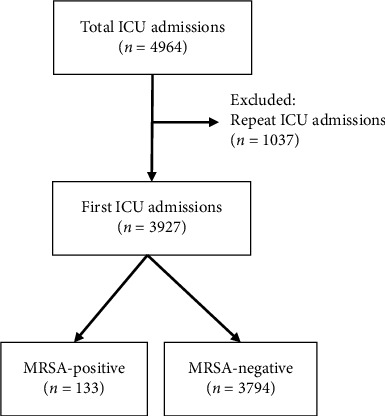
Methicillin-resistant (MRSA) is a common pathogen in the intensive care unit (ICU). Active surveillance cultures (ASCs) for MRSA are often performed in ICUs; however, they may not be optimal in ICUs with a low MRSA prevalence. This study aims to determine the risk factors of MRSA carriage in the ICU and develop a clinical predictive model to optimize the screening process. All patients who were admitted to the ICU between April 2015 and August 2022 were retrospectively included in this study. At the time of ICU admission, all patients underwent MRSA screening using nasal ASCs. Based on the screening results, patients were categorized into MRSA-positive and MRSA-negative groups. Patients' characteristics were evaluated to determine the prevalence of MRSA and the risk factors. Cost analysis was conducted based on the risk factors identified by our analysis. Of the 3927 ICU patients included, 133 (3.4%) were MRSA-positive. Multivariate analyses showed that risk factors for MRSA carriage were age ≥ 50 years (odds ratio [OR]: 2.11), history of hospitalization within a year (OR: 1.50), and ICD-10 codes classification I, IV, and XII (OR: 4.98). Screening patients based on at least one of the risk factors exhibited high sensitivity (96.9%) to identifying MRSA carriage and could reduce ASC overall costs by 10.9%, equivalent to $4686. This study suggests that universal ASCs to detect MRSA may not be optimal in ICU settings with a low prevalence of MRSA. Targeted screening based on risk factors may reduce the volume and cost of MRSA screening. Prospective multicenter studies are warranted to validate these findings and to assess the generalizability of the proposed screening strategy.
耐甲氧西林金黄色葡萄球菌(MRSA)是重症监护病房(ICU)中的常见病原体。ICU常开展针对MRSA的主动监测培养(ASC);然而,在MRSA感染率较低的ICU中,这些监测可能并非最佳选择。本研究旨在确定ICU中MRSA携带的风险因素,并开发一种临床预测模型以优化筛查流程。本研究回顾性纳入了2015年4月至2022年8月期间入住ICU的所有患者。在入住ICU时,所有患者均采用鼻腔ASC进行MRSA筛查。根据筛查结果,将患者分为MRSA阳性组和MRSA阴性组。评估患者特征以确定MRSA的感染率和风险因素。基于我们分析确定的风险因素进行成本分析。在纳入的3927例ICU患者中,133例(3.4%)为MRSA阳性。多因素分析显示,MRSA携带的风险因素为年龄≥50岁(比值比[OR]:2.11)、一年内有住院史(OR:1.50)以及国际疾病分类第十版(ICD - 10)编码分类I、IV和XII(OR:4.98)。基于至少一项风险因素对患者进行筛查,在识别MRSA携带方面表现出高敏感性(96.9%),并且可以将ASC的总体成本降低10.9%,相当于4686美元。本研究表明,在MRSA感染率较低的ICU环境中,采用普遍的ASC来检测MRSA可能并非最佳选择。基于风险因素的针对性筛查可能会减少MRSA筛查的数量和成本。有必要开展前瞻性多中心研究来验证这些发现,并评估所提出筛查策略的可推广性。