Sun Xuefeng, Qu Zihan, Zhang Xiaotu, Zhang Ye, Zhang Xinye, Zhao Haifeng, Zhang Hongshi
School of Nursing, Chang Chun University of Chinese Medicine, Changchun, China.
Rehabilitation Department, The Second People's Hospital of Dalian, Dalian, China.
Front Neurosci. 2025 Jul 22;19:1626309. doi: 10.3389/fnins.2025.1626309. eCollection 2025.
Sleep is vital for physical and mental health, yet sleep deprivation is a widespread issue that may impair cognitive flexibility, leading to rigid thinking and slower decision-making. This scoping review synthesizes evidence on the impact of sleep deprivation or sleep loss on cognitive flexibility.
To provide a comprehensive understanding of the complex and multifaceted effects of sleep deprivation on cognitive flexibility.
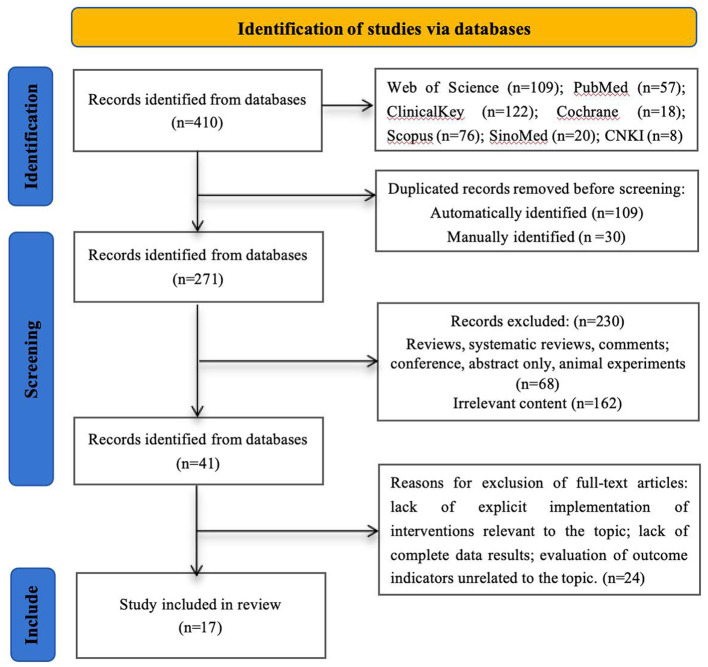
We searched PubMed, Web of Science, ClinicalKey, Cochrane, Scopus, SinoMed, and CNKI for studies evaluating the effects of sleep deprivation on cognitive flexibility. Two researchers independently screened and extracted data, assessing study quality using the Mixed Method Appraisal Tool (MMAT).
Among the 410 retrieved articles, 6 randomized controlled trials and 11 non-randomized studies were included, focusing on the impact of sleep deprivation on cognitive flexibility across children, adolescents, college students, clinicians, athletes, and other adults. Eight studies found that sleep deprivation reduces cognitive flexibility, six reported no significant impact, and two noted temporary improvements due to physical stress. One study highlighted that being overweight exacerbates the negative effects of sleep deprivation on cognitive flexibility.
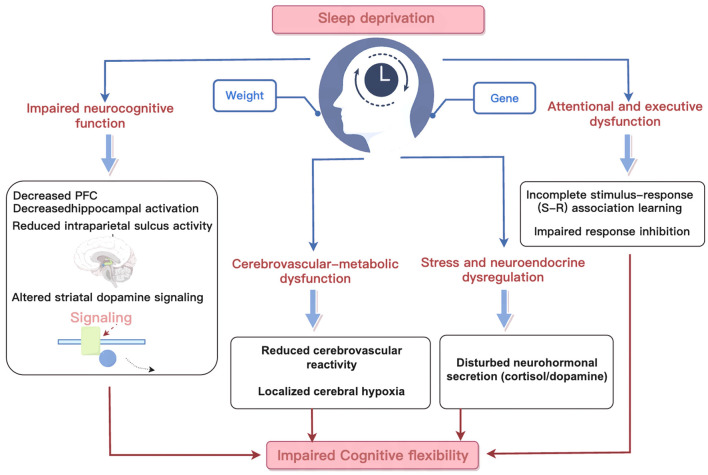
Sleep deprivation may predominantly impair accuracy rather than reaction time. Total sleep deprivation consistently reduces task-switching accuracy and cognitive flexibility, whereas partial sleep deprivation's effects remain unclear. The primary biological mechanisms involve decreased cerebral oxygen supply, impaired cerebrovascular reactivity, and alterations in gene expression and hormone levels. Rigorous randomized trials with objective measures are needed to assess long-term impacts across populations and age groups.
睡眠对身心健康至关重要,但睡眠剥夺是一个普遍存在的问题,可能会损害认知灵活性,导致思维僵化和决策速度变慢。本综述综合了关于睡眠剥夺或睡眠不足对认知灵活性影响的证据。
全面了解睡眠剥夺对认知灵活性的复杂多方面影响。
我们在PubMed、科学网、ClinicalKey、Cochrane、Scopus、中国生物医学文献数据库和中国知网中检索评估睡眠剥夺对认知灵活性影响的研究。两名研究人员独立筛选和提取数据,使用混合方法评估工具(MMAT)评估研究质量。
在检索到的410篇文章中,纳入了6项随机对照试验和11项非随机研究,重点关注睡眠剥夺对儿童、青少年、大学生、临床医生、运动员和其他成年人认知灵活性的影响。八项研究发现睡眠剥夺会降低认知灵活性,六项报告无显著影响,两项指出由于身体压力会有暂时改善。一项研究强调超重会加剧睡眠剥夺对认知灵活性的负面影响。
睡眠剥夺可能主要损害准确性而非反应时间。完全睡眠剥夺会持续降低任务转换准确性和认知灵活性,而部分睡眠剥夺的影响尚不清楚。主要的生物学机制包括脑氧供应减少、脑血管反应性受损以及基因表达和激素水平的改变。需要进行有客观测量的严格随机试验,以评估不同人群和年龄组的长期影响。