• 文献检索
  • 文档翻译
  • 深度研究
  • 学术资讯
  • Suppr Zotero 插件Zotero 插件
  • 邀请有礼
  • 套餐&价格
  • 历史记录
应用&插件
Suppr Zotero 插件Zotero 插件浏览器插件Mac 客户端Windows 客户端微信小程序
定价
高级版会员购买积分包购买API积分包
服务
文献检索文档翻译深度研究API 文档MCP 服务
关于我们
关于 Suppr公司介绍联系我们用户协议隐私条款
关注我们

Suppr 超能文献

核心技术专利:CN118964589B侵权必究
粤ICP备2023148730 号-1Suppr @ 2026

文献检索

告别复杂PubMed语法,用中文像聊天一样搜索,搜遍4000万医学文献。AI智能推荐,让科研检索更轻松。

立即免费搜索

文件翻译

保留排版,准确专业,支持PDF/Word/PPT等文件格式,支持 12+语言互译。

免费翻译文档

深度研究

AI帮你快速写综述,25分钟生成高质量综述,智能提取关键信息,辅助科研写作。

立即免费体验

目前,采用低铅钙钛矿的所有匹配钙钛矿串联太阳能电池实现了31.9%的效率并提高了稳定性。

Current matched all perovskite tandem solar cells with low lead perovskites achieving 31.9% efficiency and enhanced stability.

作者信息

Kaur Navdeep, Madan Jaya, Perumal Asaithambi, Pandey Rahul

机构信息

Centre for Research Impact & Outcome, Chitkara University Institute of Engineering and Technology, Chitkara University, Rajpura, Punjab, 140401, India.

Faculty of Civil and Environmental Engineering, Jimma Institute of Technology, Jimma University, Po Box - 378, Jimma, Ethiopia.

出版信息

Sci Rep. 2025 Aug 13;15(1):29724. doi: 10.1038/s41598-025-99575-8.

DOI:10.1038/s41598-025-99575-8
PMID:40804298
原文链接:https://pmc.ncbi.nlm.nih.gov/articles/PMC12350632/
Abstract

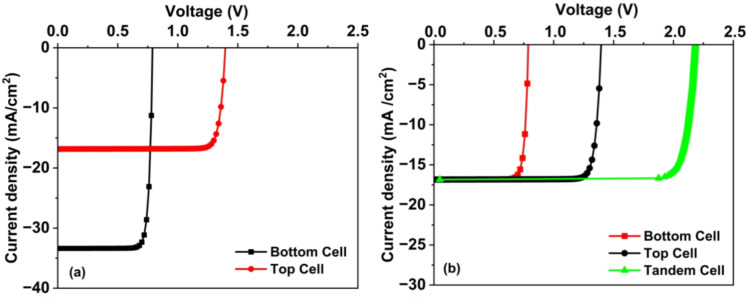
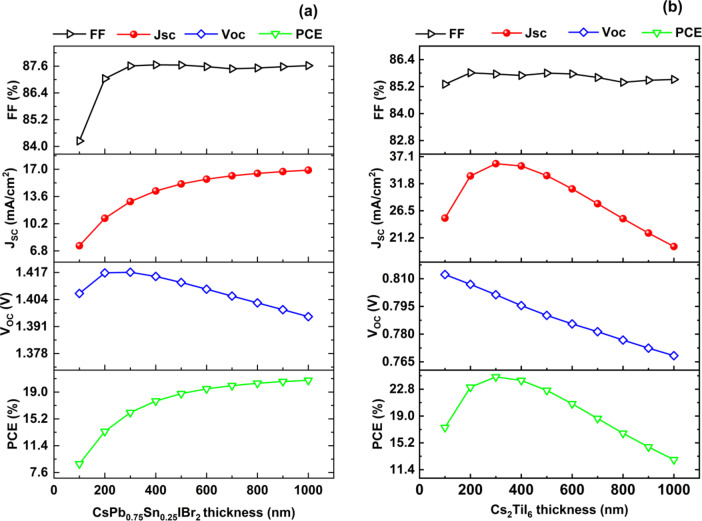
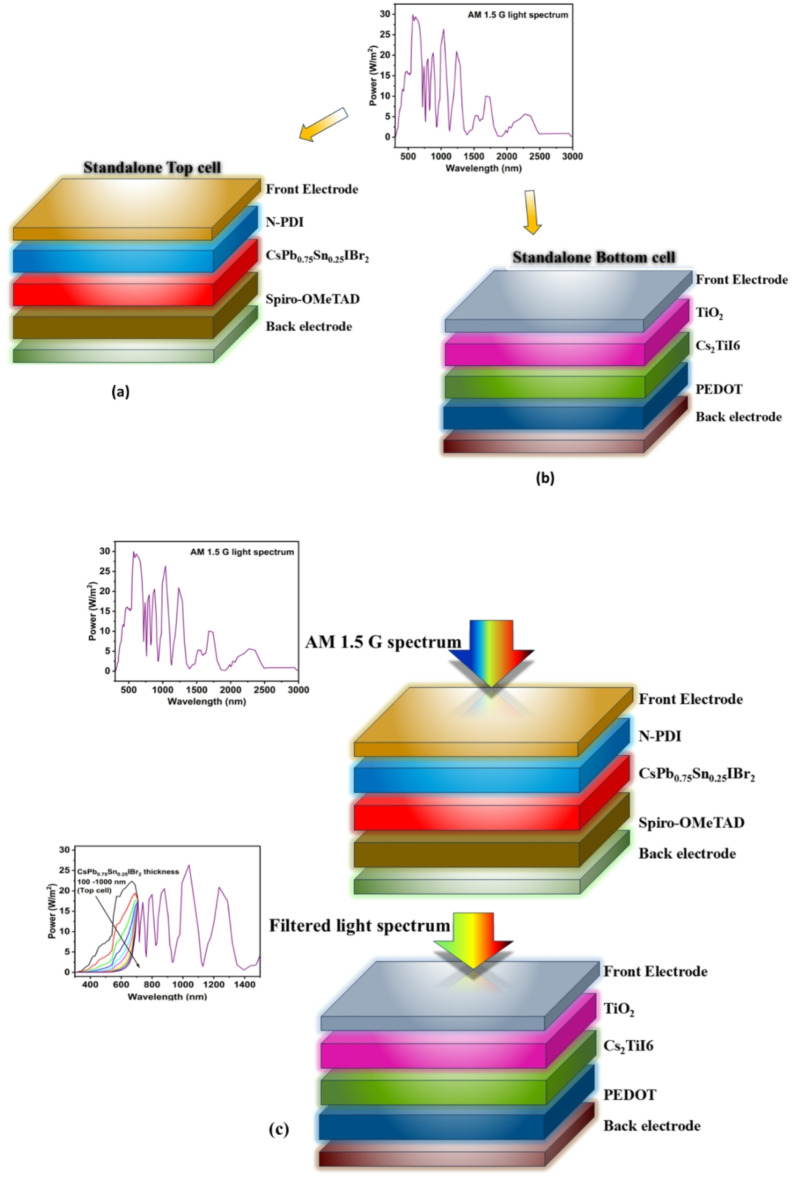
Multilayer tandem solar cells emerge as a transformative solution, leveraging multiple absorber layers with optimized bandgaps to capture and convert a broader spectrum of sunlight. This layered architecture overcomes the efficiency limitations of single-junction solar cells by minimizing transparency and thermalization losses while maximizing photon utilization across the solar spectrum. Although hybrid perovskites have demonstrated exceptional photovoltaic performance, their dependence on organic components often results in stability challenges under varying environmental conditions. To mitigate this issue, all-inorganic perovskites have emerged as a robust alternative, offering enhanced thermal and moisture stability along with reliable long-term performance. In the proposed design, a sustainable approach is adopted using a tin-based, low-lead, all-inorganic CsPbSnIBr (1.78 eV) for the top subcell absorber, paired with a lead-free double perovskite CsTiI (1.02 eV), in the bottom subcell, with the use of SCAPS - 1D simulator. Standalone analyses of the top and bottom subcells are conducted before tandem configuration implementation. Importantly, tandem design is optimized by investigating the current matching point by varying the absorber layer thicknesses (100-1000 nm). Illuminating the top subcell with the AM 1.5G spectrum and passing filtered light to the bottom subcell enables extensive light absorption and improved overall PCE. With a common current point at 16.83 mA/cm the tandem design attains a peak PCE of 31.93%, accompanied by a fill factor (FF) of 86.84% and an open-circuit voltage (V) of 2.18 V. These findings highlight the potential of this optimized tandem solar cell design to deliver high efficiency with enhanced stability, offering a promising pathway for sustainable and scalable photovoltaic technologies.

摘要

多层串联太阳能电池成为一种变革性解决方案,利用多个具有优化带隙的吸收层来捕获和转换更广泛的太阳光谱。这种分层结构通过最小化透明度和热化损失,同时最大化太阳光谱上的光子利用率,克服了单结太阳能电池的效率限制。尽管混合钙钛矿已展现出卓越的光伏性能,但其对有机成分的依赖常常导致在不同环境条件下的稳定性挑战。为缓解这一问题,全无机钙钛矿已成为一种强大的替代方案,具有增强的热稳定性和防潮性以及可靠的长期性能。在所提出的设计中,采用了一种可持续的方法,使用基于锡的低铅全无机CsPbSnIBr(1.78 eV)作为顶部子电池吸收体,与底部子电池中的无铅双钙钛矿CsTiI(1.02 eV)配对,并使用SCAPS - 1D模拟器。在串联配置实施之前,对顶部和底部子电池进行独立分析。重要的是,通过改变吸收层厚度(100 - 1000 nm)来研究电流匹配点,从而优化串联设计。用AM 1.5G光谱照射顶部子电池并将过滤后的光传递到底部子电池,可实现广泛的光吸收并提高整体光电转换效率(PCE)。在公共电流点为16.83 mA/cm²时,串联设计实现了31.93%的峰值PCE,填充因子(FF)为86.84%,开路电压(V)为2.18 V。这些发现突出了这种优化的串联太阳能电池设计在提供高效率和增强稳定性方面的潜力,为可持续和可扩展的光伏技术提供了一条有前景的途径。
https://cdn.ncbi.nlm.nih.gov/pmc/blobs/2a2b/12350632/27581703441e/41598_2025_99575_Fig16_HTML.jpg
https://cdn.ncbi.nlm.nih.gov/pmc/blobs/2a2b/12350632/71d037d41acc/41598_2025_99575_Fig1_HTML.jpg
https://cdn.ncbi.nlm.nih.gov/pmc/blobs/2a2b/12350632/71d0fbcfee43/41598_2025_99575_Fig2_HTML.jpg
https://cdn.ncbi.nlm.nih.gov/pmc/blobs/2a2b/12350632/be772c701f4c/41598_2025_99575_Fig3_HTML.jpg
https://cdn.ncbi.nlm.nih.gov/pmc/blobs/2a2b/12350632/f9a0742ca001/41598_2025_99575_Fig4_HTML.jpg
https://cdn.ncbi.nlm.nih.gov/pmc/blobs/2a2b/12350632/11b4857d67fe/41598_2025_99575_Fig5_HTML.jpg
https://cdn.ncbi.nlm.nih.gov/pmc/blobs/2a2b/12350632/66f5579e89ef/41598_2025_99575_Fig6_HTML.jpg
https://cdn.ncbi.nlm.nih.gov/pmc/blobs/2a2b/12350632/c25140917c90/41598_2025_99575_Fig7_HTML.jpg
https://cdn.ncbi.nlm.nih.gov/pmc/blobs/2a2b/12350632/70d447e305ff/41598_2025_99575_Fig8_HTML.jpg
https://cdn.ncbi.nlm.nih.gov/pmc/blobs/2a2b/12350632/c6089c961e6c/41598_2025_99575_Fig9_HTML.jpg
https://cdn.ncbi.nlm.nih.gov/pmc/blobs/2a2b/12350632/b3909f61c2bf/41598_2025_99575_Fig10_HTML.jpg
https://cdn.ncbi.nlm.nih.gov/pmc/blobs/2a2b/12350632/005b44daa8f4/41598_2025_99575_Fig11_HTML.jpg
https://cdn.ncbi.nlm.nih.gov/pmc/blobs/2a2b/12350632/616e4b480f03/41598_2025_99575_Fig12_HTML.jpg
https://cdn.ncbi.nlm.nih.gov/pmc/blobs/2a2b/12350632/760716607f66/41598_2025_99575_Fig13_HTML.jpg
https://cdn.ncbi.nlm.nih.gov/pmc/blobs/2a2b/12350632/cab857360a32/41598_2025_99575_Fig14_HTML.jpg
https://cdn.ncbi.nlm.nih.gov/pmc/blobs/2a2b/12350632/8efa464ea71c/41598_2025_99575_Fig15_HTML.jpg
https://cdn.ncbi.nlm.nih.gov/pmc/blobs/2a2b/12350632/27581703441e/41598_2025_99575_Fig16_HTML.jpg
https://cdn.ncbi.nlm.nih.gov/pmc/blobs/2a2b/12350632/71d037d41acc/41598_2025_99575_Fig1_HTML.jpg
https://cdn.ncbi.nlm.nih.gov/pmc/blobs/2a2b/12350632/71d0fbcfee43/41598_2025_99575_Fig2_HTML.jpg
https://cdn.ncbi.nlm.nih.gov/pmc/blobs/2a2b/12350632/be772c701f4c/41598_2025_99575_Fig3_HTML.jpg
https://cdn.ncbi.nlm.nih.gov/pmc/blobs/2a2b/12350632/f9a0742ca001/41598_2025_99575_Fig4_HTML.jpg
https://cdn.ncbi.nlm.nih.gov/pmc/blobs/2a2b/12350632/11b4857d67fe/41598_2025_99575_Fig5_HTML.jpg
https://cdn.ncbi.nlm.nih.gov/pmc/blobs/2a2b/12350632/66f5579e89ef/41598_2025_99575_Fig6_HTML.jpg
https://cdn.ncbi.nlm.nih.gov/pmc/blobs/2a2b/12350632/c25140917c90/41598_2025_99575_Fig7_HTML.jpg
https://cdn.ncbi.nlm.nih.gov/pmc/blobs/2a2b/12350632/70d447e305ff/41598_2025_99575_Fig8_HTML.jpg
https://cdn.ncbi.nlm.nih.gov/pmc/blobs/2a2b/12350632/c6089c961e6c/41598_2025_99575_Fig9_HTML.jpg
https://cdn.ncbi.nlm.nih.gov/pmc/blobs/2a2b/12350632/b3909f61c2bf/41598_2025_99575_Fig10_HTML.jpg
https://cdn.ncbi.nlm.nih.gov/pmc/blobs/2a2b/12350632/005b44daa8f4/41598_2025_99575_Fig11_HTML.jpg
https://cdn.ncbi.nlm.nih.gov/pmc/blobs/2a2b/12350632/616e4b480f03/41598_2025_99575_Fig12_HTML.jpg
https://cdn.ncbi.nlm.nih.gov/pmc/blobs/2a2b/12350632/760716607f66/41598_2025_99575_Fig13_HTML.jpg
https://cdn.ncbi.nlm.nih.gov/pmc/blobs/2a2b/12350632/cab857360a32/41598_2025_99575_Fig14_HTML.jpg
https://cdn.ncbi.nlm.nih.gov/pmc/blobs/2a2b/12350632/8efa464ea71c/41598_2025_99575_Fig15_HTML.jpg
https://cdn.ncbi.nlm.nih.gov/pmc/blobs/2a2b/12350632/27581703441e/41598_2025_99575_Fig16_HTML.jpg

相似文献

1
Current matched all perovskite tandem solar cells with low lead perovskites achieving 31.9% efficiency and enhanced stability.目前,采用低铅钙钛矿的所有匹配钙钛矿串联太阳能电池实现了31.9%的效率并提高了稳定性。
Sci Rep. 2025 Aug 13;15(1):29724. doi: 10.1038/s41598-025-99575-8.
2
Numerical Simulation Analysis of Two-Terminal Monolithic Perovskite-CIGS Tandem Solar Cell for Enhanced Photovoltaic Performance Using SCAPS-1d.基于SCAPS-1d的用于增强光伏性能的双端单片钙钛矿-CIGS串联太阳能电池的数值模拟分析
Langmuir. 2025 Aug 5;41(30):19729-19741. doi: 10.1021/acs.langmuir.5c01551. Epub 2025 Jul 23.
3
Prescription of Controlled Substances: Benefits and Risks管制药品的处方:益处与风险
4
A numerical investigation to design and performance optimization of lead-free CsTiClbased perovskite solar cells with different charge transport layers.关于具有不同电荷传输层的无铅CsTiCl基钙钛矿太阳能电池的设计与性能优化的数值研究。
Sci Rep. 2025 Jul 1;15(1):20768. doi: 10.1038/s41598-025-06820-1.
5
Exploring Optoelectronic Behavior and Solar Cell Efficiency of Double Halide Perovskites MKIrCl (M = Cs, Rb) through DFT and SCAPS-1D.通过密度泛函理论(DFT)和SCAPS-1D探索双卤化物钙钛矿MKIrCl(M = Cs,Rb)的光电行为和太阳能电池效率。
Langmuir. 2025 Aug 5;41(30):19797-19820. doi: 10.1021/acs.langmuir.5c01639. Epub 2025 Jul 27.
6
SCAPS simulation and design of highly efficient CuBiO-based thin-film solar cells (TFSCs) with hole and electron transport layers.基于SCAPS的具有空穴和电子传输层的高效CuBiO基薄膜太阳能电池(TFSCs)的模拟与设计
Sci Rep. 2025 Aug 3;15(1):28300. doi: 10.1038/s41598-025-12091-7.
7
Design Optimization of Cesium Contents for Mixed Cation MACsPbI-Based Efficient Perovskite Solar Cell.基于混合阳离子MACsPbI的高效钙钛矿太阳能电池铯含量的设计优化
Nanomaterials (Basel). 2025 Jul 13;15(14):1085. doi: 10.3390/nano15141085.
8
Perovskitoids as Functional Materials.钙钛矿类材料作为功能材料。
Acc Chem Res. 2025 Jul 15;58(14):2243-2254. doi: 10.1021/acs.accounts.5c00240. Epub 2025 Jun 27.
9
Exploration and optimization of different charge transport layers for CsCuSbCl based perovskite solar cells.基于CsCuSbCl的钙钛矿太阳能电池不同电荷传输层的探索与优化
Sci Rep. 2025 Jul 11;15(1):25100. doi: 10.1038/s41598-025-10731-6.
10
High-efficiency and eco-friendly CsSnBr-based perovskite solar cells: optimized device architecture and performance analysis via SCAPS-1D simulation.高效且环保的基于CsSnBr的钙钛矿太阳能电池:通过SCAPS-1D模拟优化器件结构与性能分析
Opt Express. 2025 Jul 14;33(14):30441-30462. doi: 10.1364/OE.566116.

本文引用的文献

1
All-perovskite tandem solar cells achieving >29% efficiency with improved (100) orientation in wide-bandgap perovskites.全钙钛矿串联太阳能电池在宽带隙钙钛矿中具有改进的(100)取向,效率超过29%。
Nat Mater. 2025 Feb;24(2):252-259. doi: 10.1038/s41563-024-02073-x. Epub 2025 Jan 10.
2
Durable all-inorganic perovskite tandem photovoltaics.耐用的全无机钙钛矿串联太阳能电池。
Nature. 2025 Jan;637(8048):1111-1117. doi: 10.1038/s41586-024-08432-7. Epub 2024 Nov 28.
3
Achievements, challenges, and future prospects for industrialization of perovskite solar cells.
钙钛矿太阳能电池产业化的成就、挑战与未来前景
Light Sci Appl. 2024 Sep 3;13(1):227. doi: 10.1038/s41377-024-01461-x.
4
Stable and Lead-Safe Polyphenol-Encapsulated Perovskite Solar Cells.稳定且无铅的多酚封装钙钛矿太阳能电池。
Adv Sci (Weinh). 2024 Aug;11(31):e2403057. doi: 10.1002/advs.202403057. Epub 2024 Jun 18.
5
Comprehensive analysis of heterojunction compatibility of various perovskite solar cells with promising charge transport materials.对各种具有前景的电荷传输材料的钙钛矿太阳能电池的异质结兼容性进行综合分析。
Sci Rep. 2023 Nov 3;13(1):19015. doi: 10.1038/s41598-023-46482-5.
6
SCAPS study on the effect of various hole transport layer on highly efficient 31.86% eco-friendly CZTS based solar cell.SCAPS关于各种空穴传输层对基于环保型CZTS的高效31.86%太阳能电池影响的研究。
Sci Rep. 2023 Oct 27;13(1):18411. doi: 10.1038/s41598-023-44845-6.
7
CsTiI (CsTiIBr) Halide Perovskite Solar Cell and Its Point Defect Analysis.CsTiI(CsTiIBr)卤化物钙钛矿太阳能电池及其点缺陷分析。
Nanomaterials (Basel). 2023 Jul 19;13(14):2100. doi: 10.3390/nano13142100.
8
Deep Insights into the Coupled Optoelectronic and Photovoltaic Analysis of Lead-Free CsSnI Perovskite-Based Solar Cell Using DFT Calculations and SCAPS-1D Simulations.基于密度泛函理论(DFT)计算和SCAPS-1D模拟对无铅CsSnI钙钛矿基太阳能电池的耦合光电与光伏分析的深入洞察。
ACS Omega. 2023 Jun 14;8(25):22466-22485. doi: 10.1021/acsomega.3c00306. eCollection 2023 Jun 27.
9
Oxidation-resistant all-perovskite tandem solar cells in substrate configuration.基底结构中氧化稳定的全钙钛矿串联太阳能电池。
Nat Commun. 2023 Mar 31;14(1):1819. doi: 10.1038/s41467-023-37492-y.
10
An extensive study on multiple ETL and HTL layers to design and simulation of high-performance lead-free CsSnCl-based perovskite solar cells.对多层 ETL 和 HTL 进行广泛研究,以设计和模拟高性能无铅 CsSnCl 基钙钛矿太阳能电池。
Sci Rep. 2023 Feb 13;13(1):2521. doi: 10.1038/s41598-023-28506-2.