Bahadori Shayan, Buckle Peter, Soukup Ascensao Tayana, Ghafur Saira, Kierkegaard Patrick
Department of Surgery and Cancer, Faculty of Medicine, Imperial College London, London, United Kingdom.
JMIR Mhealth Uhealth. 2025 Aug 22;13:e67435. doi: 10.2196/67435.
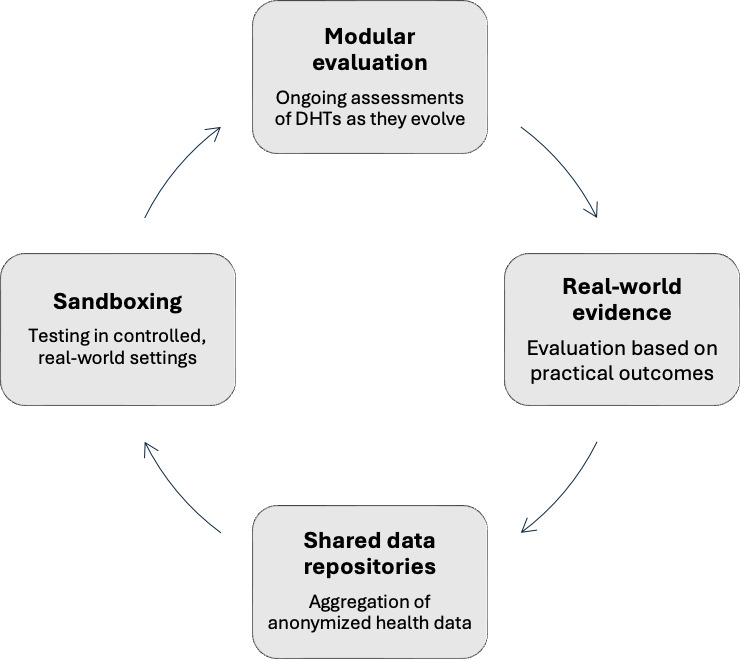
The rapid advancement of artificial intelligence (AI)-driven diagnostics and wearable health technologies is transforming health care delivery by enabling real-time health monitoring and early disease detection. These innovations are catalyzing a shift toward personalized medicine, with interventions tailored to individual patient profiles with unprecedented precision. This paper examines the current National Institute for Health and Care Excellence (NICE) evidence standards framework (ESF) for digital health technologies (DHTs) and evaluates the challenges associated with integrating DHTs into existing health and care systems. A comprehensive review of the NICE ESF guidelines was conducted, alongside an evaluation of their applicability to emerging AI and wearable technologies. Key limitations and barriers were identified, with particular focus on the framework's responsiveness to technologies that evolve through machine learning and real-world data integration. Our findings indicate that while the NICE ESF provides a structured approach for evaluating DHTs, it lacks the adaptability required for rapidly evolving innovations. The framework does not sufficiently incorporate real-world evidence or support continuous learning models, which are critical for the safe and effective deployment of AI-based diagnostics and wearables. To remain effective and relevant, the NICE ESF should transition to a dynamic, adaptive model co-designed with industry stakeholders. By embedding real-world evidence-based strategies and promoting transparency, efficiency, and collaborative innovation, the updated framework would better facilitate the integration of AI-driven diagnostics and wearables into health care systems, ultimately enhancing patient outcomes and optimizing health care delivery.
人工智能驱动的诊断技术和可穿戴健康技术的迅速发展正在改变医疗保健服务方式,实现实时健康监测和疾病早期检测。这些创新正在推动向个性化医疗的转变,针对个体患者档案进行的干预达到了前所未有的精准度。本文研究了英国国家卫生与临床优化研究所(NICE)目前针对数字健康技术(DHTs)的证据标准框架(ESF),并评估了将DHTs整合到现有卫生保健系统中所面临的挑战。对NICE ESF指南进行了全面审查,并评估了其对新兴人工智能和可穿戴技术的适用性。确定了关键的局限性和障碍,特别关注该框架对通过机器学习和现实世界数据整合而不断发展的技术的响应能力。我们的研究结果表明,虽然NICE ESF为评估DHTs提供了一种结构化方法,但它缺乏快速发展的创新所需的适应性。该框架没有充分纳入现实世界的证据,也不支持持续学习模型,而这对于基于人工智能的诊断和可穿戴设备的安全有效部署至关重要。为了保持有效性和相关性,NICE ESF应转向与行业利益相关者共同设计的动态、适应性模型。通过纳入基于现实世界证据的策略,促进透明度、效率和合作创新,更新后的框架将更好地促进基于人工智能的诊断和可穿戴设备融入卫生保健系统,最终改善患者预后并优化医疗保健服务。