Hariati Suni, Erfina Erfina, Febriani Andi Dwi Bahagia, Alasiry Ema, Asriaty Asriaty, Haerani Haerani
Pediatrics Nursing Department, Faculty of Nursing, Hasanuddin University, Makassar City, 90245, Indonesia.
Maternity Nursing Department, Faculty of Nursing, Hasanuddin University, Makassar City, 90245, Indonesia.
Sci Rep. 2025 Aug 23;15(1):31028. doi: 10.1038/s41598-025-15342-9.
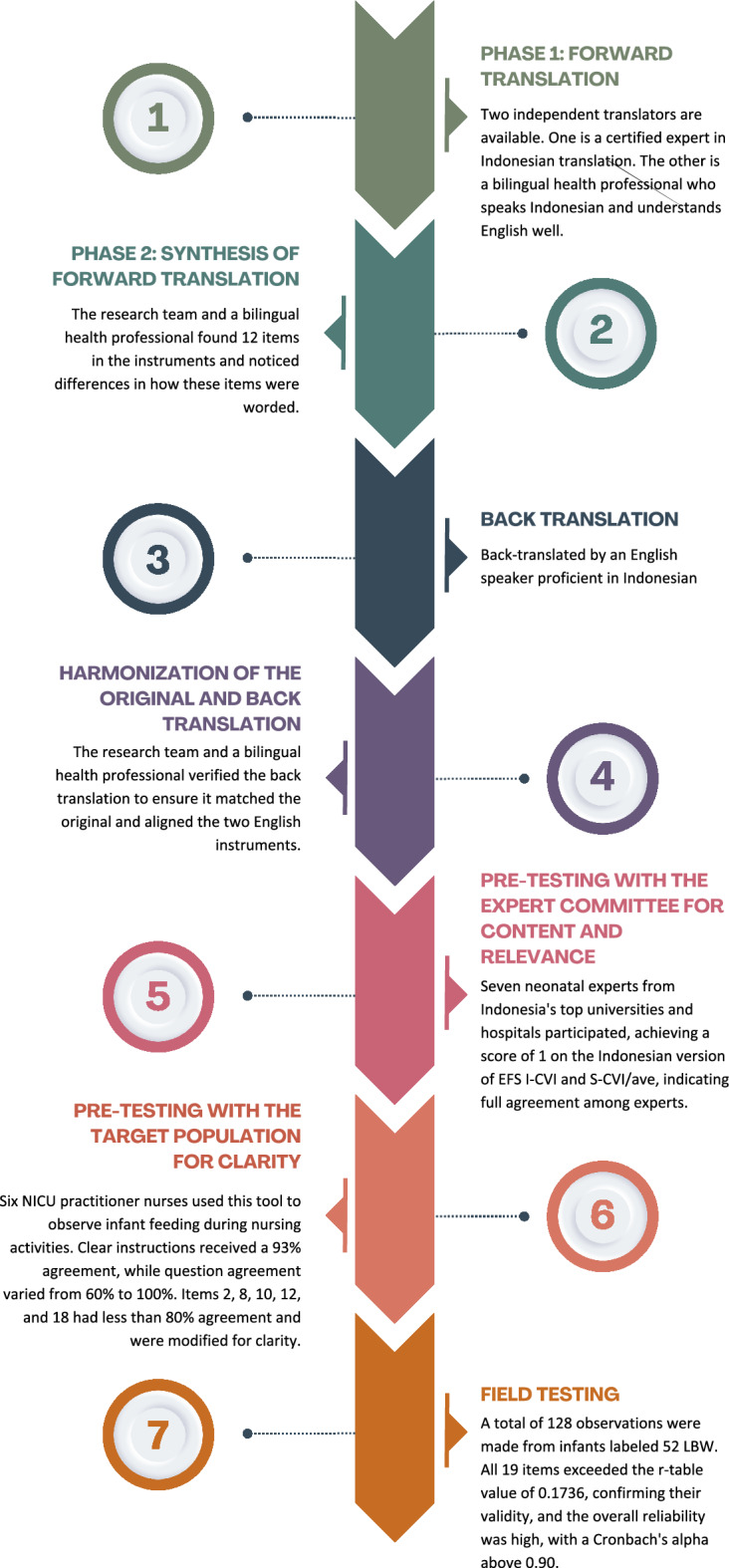
Initiating oral feeding at inappropriate times can cause stress and complications for Low Birth Weight (LBW) infants. It is essential to assess the infant's readiness for oral feeding to minimize stress and support the transition to full oral feeding. An objective assessment tool is necessary to improve the accuracy of determining the right time to start oral feedings. This study aimed to translate, adapt, and psychometrically validate the original English version of the Early Feeding Skill Assessment Tool (EFS) into the Indonesian language. The EFS questionnaire, an observation instrument with 19 items, uses a 3-option scoring structure: not yet evident, emerging, or consistently observed. The following EFS adaptation phases: (1) forward translation; (2) synthesis of forward translation; (3) back translation; (4) harmonization of the original and back translation; (4) pre-testing with the expert committee for content and relevance; (5) pre-testing with target user population for clarity; and (6) field testing. The translation was carried out by a certified translator in conjunction with a bilingual health professional. Seven neonatal experts participated in the pre-testing phase, while six nurses engaged with the target population for further evaluation. A total of 128 observations were conducted on infants exhibiting stable hemodynamics during the field testing phase. The two forward translations differed in 12 items, leading to expert discussions and consensus on the translation. The pre-testing among seven expert for content validity showed The EFS I-CVI and S-CVI/ave were 1 for all questions, indicating full expert agreement. The pre-testing among six nurses for face validity showed clear instructions (93%), with question agreement ranging from 60 to 100%. Six items had < 80% agreement and were rewritten as suggest from nurses. In field testing from 128 observations among 52 LBW infants revealed 19 items were valid and their reliability was 0.918. The 19-item EFS Indonesian version is valid and reliable for LBW infants. It can be used to implement as an assessment for a common language for infant feeding skills among interprofessional teams, contributing to infant feeding success.
在不恰当的时间开始经口喂养会给低出生体重(LBW)婴儿带来压力和并发症。评估婴儿经口喂养的准备情况以尽量减少压力并支持向完全经口喂养的过渡至关重要。需要一种客观的评估工具来提高确定开始经口喂养正确时间的准确性。本研究旨在将早期喂养技能评估工具(EFS)的原始英文版翻译、改编并进行心理测量学验证,使其适用于印度尼西亚语。EFS问卷是一种包含19个条目的观察工具,采用三选项评分结构:尚未显现、正在出现或持续观察到。以下是EFS的改编阶段:(1)正向翻译;(2)正向翻译的综合;(3)回译;(4)原文与回译的协调;(4)与专家委员会进行内容和相关性的预测试;(5)与目标用户群体进行清晰度的预测试;以及(6)现场测试。翻译由一名认证翻译人员与一名双语健康专业人员共同进行。七名新生儿专家参与了预测试阶段,六名护士与目标人群接触以进行进一步评估。在现场测试阶段,对血流动力学稳定的婴儿共进行了128次观察。两次正向翻译在12个条目中存在差异,引发了专家讨论并就翻译达成共识。七名专家进行的内容效度预测试显示,所有问题的EFS I-CVI和S-CVI/ave均为1,表明专家完全一致同意。六名护士进行的表面效度预测试显示,说明清晰(93%),问题的同意率在60%至100%之间。六个条目同意率低于80%,按照护士的建议进行了改写。在对52名低出生体重婴儿进行的128次观察的现场测试中,发现19个条目有效,其信度为0.918。19个条目的EFS印尼语版本对低出生体重婴儿有效且可靠。它可作为跨专业团队中婴儿喂养技能通用语言的评估工具,有助于婴儿喂养成功。