Lin Peng, Shen Jiacheng, Jiang Xinyi, Liu Fenghao, Hou Youming
State Key Laboratory of Agricultural and Forestry Biosafety, Fujian Agriculture and Forestry University, Fuzhou 350002, China.
Insects. 2025 Jul 25;16(8):766. doi: 10.3390/insects16080766.
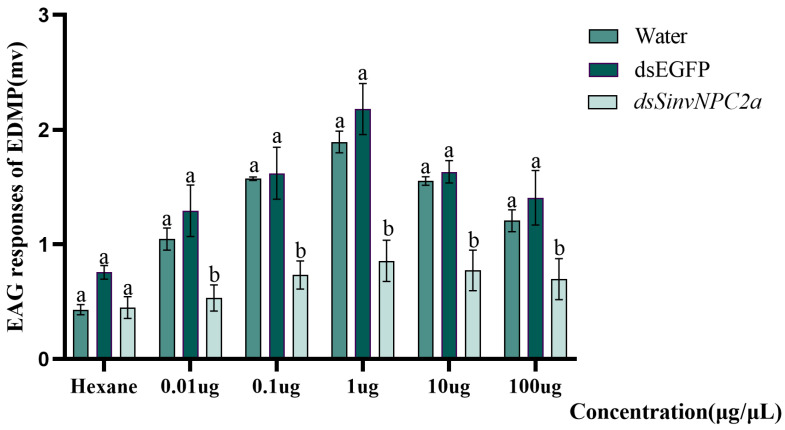
The red imported fire ant () is a dangerous invasive insect. These ants rely on releasing an alarm pheromone, mainly composed of 2-ethyl-3,6-dimethylptrazine (EDMP), to warn nestmates of danger and trigger group defense or escape behaviors. This study found two NPC2 proteins in the ant antennae: SinvNPC2a and SinvNPC2b. SinvNPC2a was highly expressed in the antennae; phylogenetic analysis also suggests that SinvNPC2 likely possesses conserved olfactory recognition functions. By knocking down the SinvNPC2a gene, we found that the electrophysiological response of ant antennae to EDMP became weaker. More importantly, ants lacking SinvNPC2a showed significantly reduced movement range and speed when exposed to EDMP, compared to normal ants not treated with RNAi. These ants did not spread out quickly. Furthermore, tests showed that the purified SinvNPC2a protein could directly bind to EDMP molecules. Computer modeling also showed that they fit together tightly. These findings provide direct evidence that the SinvNPC2a protein plays a key role in helping fire ants detect the EDMP alarm pheromone. It enables the ants to sense this chemical signal, allowing ant colonies to respond quickly. Understanding this mechanism improves our knowledge of how insects smell things. It also suggests a potential molecular target for developing new methods to control fire ants, such as using RNAi to block its function.
红火蚁是一种危险的入侵性昆虫。这些蚂蚁依靠释放一种主要由2-乙基-3,6-二甲基吡嗪(EDMP)组成的警报信息素来警告巢友危险,并触发群体防御或逃避行为。本研究在蚂蚁触角中发现了两种NPC2蛋白:SinvNPC2a和SinvNPC2b。SinvNPC2a在触角中高度表达;系统发育分析也表明SinvNPC2可能具有保守的嗅觉识别功能。通过敲低SinvNPC2a基因,我们发现蚂蚁触角对EDMP的电生理反应变弱。更重要的是,与未用RNAi处理的正常蚂蚁相比,缺乏SinvNPC2a的蚂蚁在接触EDMP时显示出移动范围和速度显著降低。这些蚂蚁没有迅速散开。此外,测试表明纯化的SinvNPC2a蛋白可以直接与EDMP分子结合。计算机建模也表明它们紧密结合在一起。这些发现提供了直接证据,证明SinvNPC2a蛋白在帮助火蚁检测EDMP警报信息素方面起关键作用。它使蚂蚁能够感知这种化学信号,使蚁群能够迅速做出反应。了解这一机制提高了我们对昆虫如何嗅闻事物的认识。它还暗示了开发控制火蚁新方法的潜在分子靶点,例如使用RNAi来阻断其功能。