McCallister Erin, Russell Nicholas
School of Allied Health Professions, Louisiana State University Health Sciences Center at Shreveport, Shreveport, LA, USA.
Int J Exerc Sci. 2025 Sep 1;18(7):712-726. doi: 10.70252/DMWA1583. eCollection 2025.
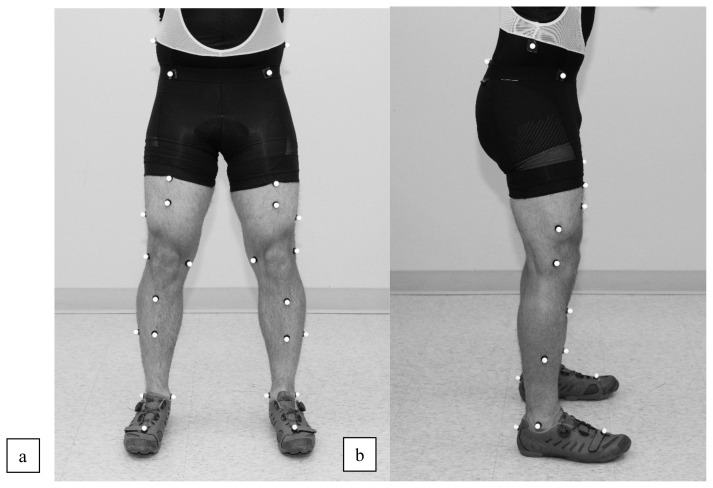
Motion analysis is used to measure proper bicycle fit, avoid injury, and improve cycling performance. Small changes in position can impact joint kinematics and risk for overuse injury. Concerns regarding the often-used biomechanical model Plug-in-Gait (PIG) resulted in the creation of Conventional Gait Model 2 (CGM2). This study aims to compare kinematic outputs of these two models for cycling biomechanics plus between-day reliability of each model. Thirty-five participants participated in two experimental sessions. PiG and CGM2 marker sets were applied, and data was collected while cycling between 80-90 rpm. Model outputs were compared using session one kinematic data. Reliability tests used session one and session two data. Differences in kinematics were found between models for hip flexion (CGM2 - PiG mean difference = -8.2° ± 5.2°, < .001), hip frontal plane (mean = 5.4 ± 4.1°, < .001), hip transverse plane (mean = -5.3° ± 11.6°, = .011), knee extension (mean = 1.8° ± 4.2°, = .015), knee frontal plane (mean = -10.8° ± 9.6°, < .001), dorsiflexion (mean = -1.7° ± 3.6°, = 0.005), and plantarflexion (mean = 3.3° ± 5.4°, < 0.001). CGM2 ICCs were good-to-excellent (> 0.75) for all motions except frontal plane knee motion. PiG ICCs were > 0.75 only for ankle dorsiflexion and plantarflexion. If CGM2 is used to assess bicycle fit, reference values should be adjusted based on the difference between models to ensure an appropriate fit is obtained. CGM2 has better between-day reliability, therefore practitioners may consider using CGM2 for serial fit sessions.
运动分析用于测量自行车的合适度、预防损伤并提高骑行表现。姿势的微小变化会影响关节运动学以及过度使用损伤的风险。对常用的生物力学模型“插入式步态模型(PIG)”的担忧导致了传统步态模型2(CGM2)的创建。本研究旨在比较这两种模型在自行车生物力学方面的运动学输出以及各模型的日间可靠性。35名参与者参加了两个实验环节。应用了PIG和CGM2标记集,并在以80 - 90转/分钟的速度骑行时收集数据。使用第一个环节的运动学数据比较模型输出。可靠性测试使用了第一个环节和第二个环节的数据。发现模型之间在髋关节屈曲(CGM2 - PIG平均差异 = -8.2°±5.2°,P <.001)、髋关节额状面(平均 = 5.4±4.1°,P <.001)、髋关节横断面(平均 = -5.3°±11.6°,P =.011)、膝关节伸展(平均 = 1.8°±4.2°,P =.015)、膝关节额状面(平均 = -10.8°±9.6°,P <.001)、背屈(平均 = -1.7°±3.6°,P = 0.005)和跖屈(平均 = 3.3°±5.4°,P < 0.001)方面存在运动学差异。除了膝关节额状面运动外,CGM2的组内相关系数(ICC)对于所有运动均为良好至优秀(> 0.75)。PIG的ICC仅在踝关节背屈和跖屈时大于0.75。如果使用CGM2来评估自行车的合适度,应根据模型之间的差异调整参考值,以确保获得合适的贴合度。CGM2具有更好的日间可靠性,因此从业者可考虑在连续的合适度评估环节中使用CGM2。