Lin John C, McCarthy Madison, Potluri Sriya, Nguyen Dang, Yan Ruiqi, Aysola Jaya
Department of Medicine, Perelman School of Medicine, University of Pennsylvania, Philadelphia.
Penn Medicine Center for Health Equity Advancement, University of Pennsylvania Health System, Philadelphia.
JAMA Netw Open. 2025 Sep 2;8(9):e2530730. doi: 10.1001/jamanetworkopen.2025.30730.
Long COVID (ie, post-COVID-19 condition) is a substantial public health concern, and its association with health-related social needs, such as food insecurity, remains poorly understood. Identifying modifiable risk factors like food insecurity and interventions like food assistance programs is critical for reducing the health burden of long COVID.
To investigate the association of food insecurity with long COVID and to assess the modifying factors of Supplemental Nutrition Assistance Program (SNAP) participation and employment status.
DESIGN, SETTING, AND PARTICIPANTS: This retrospective, cross-sectional survey study used data from the 2022 to 2023 National Health Interview Survey. Respondents aged 18 years and older who reported prior COVID-19 infection and responded to questions on food insecurity and long COVID were included.
Food insecurity, categorized as food secure or food insecure.
The primary outcome was current long COVID, defined as symptoms lasting 3 or more months after initial COVID-19 infection persisting to time of interview. The secondary outcome was long COVID recovery, indicating history of long COVID without current symptoms. Food insecurity was measured using the validated 10-item National Center for Health Statistics food insecurity scale. Odds ratios (ORs) and 95% CIs for the association of food insecurity with long COVID were calculated using simple and multiple logistic regression.
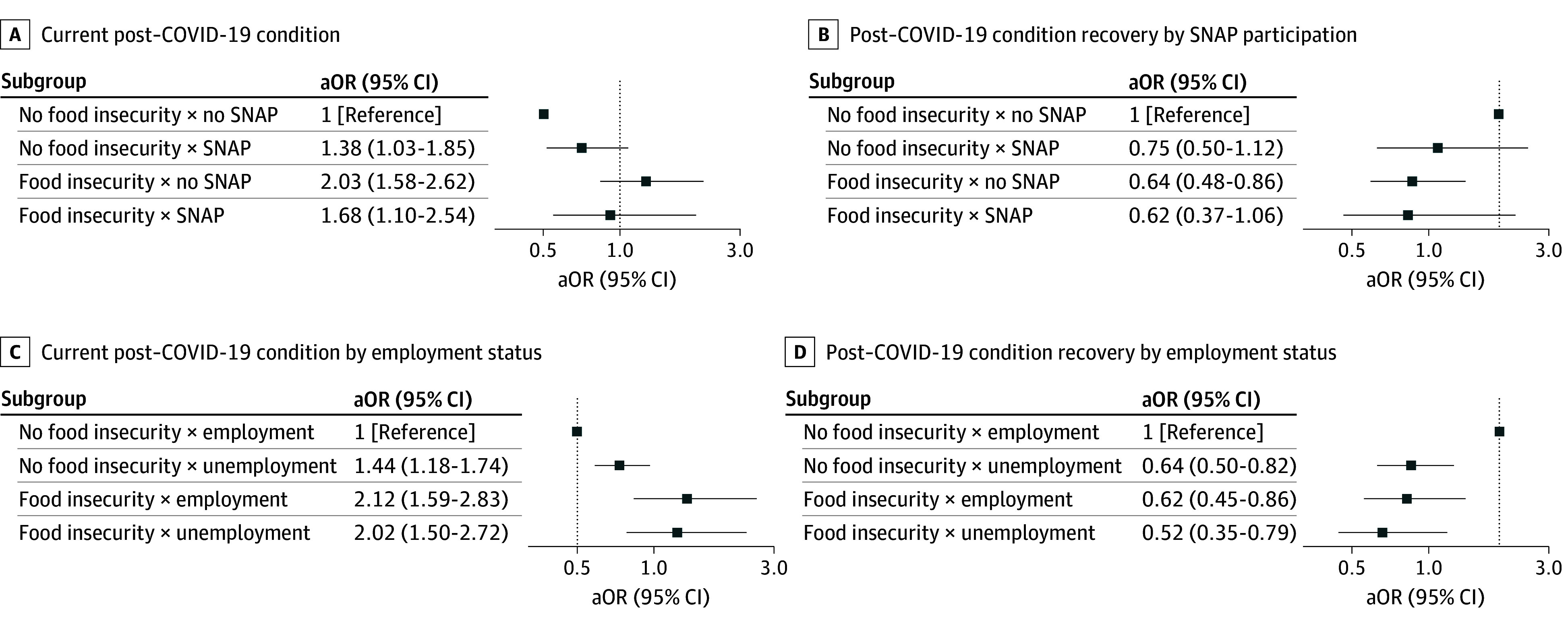
The study enrolled 21 631 participants (1255 female [weighted percentage, 53%]; 5058 aged 65 years or older [weighted percentage, 16%]), including 19 824 with food security and 1807 with food insecurity. In total, 288 respondents with food insecurity (weighted percentage, 15%) reported current long COVID compared with 1547 (weighted percentage, 7%) without food insecurity. Food insecurity was positively associated with current long COVID (adjusted OR, 1.73; 95% CI, 1.39-2.15) and negatively associated with recovery among adults with prior long COVID (adjusted OR, 0.70; 95% CI, 0.54-0.92). SNAP participation (P for interaction = .04) and unemployment (P for interaction = .04) significantly modified these associations.
In this survey study of US adults with prior COVID-19 infection, food insecurity was associated with greater odds of long COVID and lower odds of recovery, with SNAP participation and unemployment mitigating these associations. These findings suggest that expanding SNAP eligibility, simplifying enrollment processes, and increasing awareness of food assistance programs may reduce the burden of food insecurity and long COVID and further emphasize the importance of addressing health-related social needs in chronic disease prevention and management.
长期新冠(即新冠后状况)是一个重大的公共卫生问题,其与粮食不安全等与健康相关的社会需求之间的关联仍知之甚少。识别像粮食不安全这样的可改变风险因素以及像粮食援助计划这样的干预措施对于减轻长期新冠的健康负担至关重要。
调查粮食不安全与长期新冠之间的关联,并评估补充营养援助计划(SNAP)参与情况和就业状况的调节因素。
设计、背景和参与者:这项回顾性横断面调查研究使用了2022年至2023年全国健康访谈调查的数据。纳入了18岁及以上报告曾感染新冠且回答了有关粮食不安全和长期新冠问题的受访者。
粮食不安全,分为粮食安全或粮食不安全。
主要结局是当前的长期新冠,定义为初次感染新冠后持续3个月或更长时间且持续到访谈时仍存在的症状。次要结局是长期新冠康复,表明曾有长期新冠病史但目前无症状。粮食不安全使用经过验证的10项国家卫生统计中心粮食不安全量表进行测量。使用简单和多元逻辑回归计算粮食不安全与长期新冠关联的比值比(OR)和95%置信区间(CI)。
该研究纳入了21631名参与者(1255名女性[加权百分比,53%];5058名65岁及以上[加权百分比,16%]),其中19824人粮食安全,1807人粮食不安全。总共有288名粮食不安全的受访者(加权百分比,15%)报告当前患有长期新冠,而1547名(加权百分比,7%)粮食安全的受访者未患长期新冠。粮食不安全与当前的长期新冠呈正相关(调整后的OR,1.73;95%CI,1.39 - 2.15),与曾患长期新冠的成年人的康复呈负相关(调整后的OR,0.70;95%CI,0.54 - 0.92)。SNAP参与情况(交互作用P值 = 0.04)和失业情况(交互作用P值 = 0.04)显著改变了这些关联。
在这项对曾感染新冠的美国成年人的调查研究中,粮食不安全与长期新冠的更高几率以及康复的更低几率相关,SNAP参与和失业减轻了这些关联。这些发现表明,扩大SNAP资格范围、简化登记流程以及提高对粮食援助计划的认识可能会减轻粮食不安全和长期新冠的负担,并进一步强调在慢性病预防和管理中解决与健康相关的社会需求的重要性。