Duggal Mona, Chauhan Anshul, Gupta Vishali, Kankaria Ankita, Budhija Deepmala, Verma Priyanka, Miglani Vaibhav, Syal Preeti, Kaur Gagandeep, Kumar Lakshay, Mutyala Naveen, Bezbaruah Rishabh, Sood Nayanshi, Kernohan Ashleigh, Menon Geeta, Vale Luke
ICMR-National Institute for Research in Digital Health and Data Science (NIRDHDS), Ansari Nagar East, New Delhi, 110029, India, 91-11-26588803.
Advanced Eye Centre, Post Graduate Institute of Medical Education and Research, Chandigarh, 160012, India.
JMIR Med Inform. 2025 Sep 9;13:e67529. doi: 10.2196/67529.
Artificial intelligence (AI) algorithms offer an effective solution to alleviate the burden of diabetic retinopathy (DR) screening in public health settings. However, there are challenges in translating diagnostic performance and its application when deployed in real-world conditions.
This study aimed to assess the technical feasibility of integration and diagnostic performance of validated DR screening (DRS) AI algorithms in real-world outpatient public health settings.
Prior to integrating an AI algorithm for DR screening, the study involved several steps: (1) Five AI companies, including four from India and one international company, were invited to evaluate their diagnostic performance using low-cost nonmydriatic fundus cameras in public health settings; (2) The AI algorithms were prospectively validated on fundus images from 250 people with diabetes mellitus, captured by a trained optometrist in public health settings in Chandigarh Tricity in North India. The performance evaluation used diagnostic metrics, including sensitivity, specificity, and accuracy, compared to human grader assessments; (3) The AI algorithm with better diagnostic performance was integrated into a low-cost screening camera deployed at a community health center (CHC) in the Moga district of Punjab, India. For AI algorithm analysis, a trained health system optometrist captured nonmydriatic images of 343 patients.
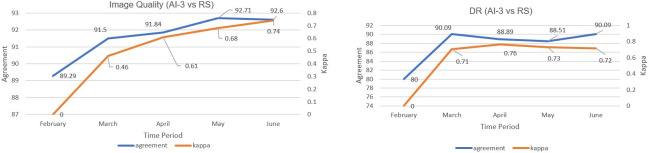
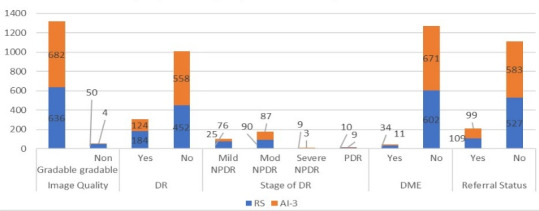
Three web-based AI screening companies agreed to participate, while one declined and one chose to withdraw due to low specificity identified during the interim analysis. The three AI algorithms demonstrated variable diagnostic performance, with sensitivity (60%-80%) and specificity (14%-96%). Upon integration, the better-performing algorithm AI-3 (sensitivity: 68%, specificity: 96, and accuracy: 88·43%) demonstrated high sensitivity of image gradability (99.5%), DR detection (99.6%), and referral DR (79%) at the CHC.
This study highlights the importance of systematic AI validation for responsible clinical integration, demonstrating the potential of DRS to improve health care access in resource-limited public health settings.
人工智能(AI)算法为减轻公共卫生环境中糖尿病视网膜病变(DR)筛查负担提供了有效解决方案。然而,在实际应用中,将诊断性能及其应用进行转化存在挑战。
本研究旨在评估经过验证的DR筛查(DRS)AI算法在实际门诊公共卫生环境中的集成技术可行性和诊断性能。
在集成用于DR筛查的AI算法之前,该研究包括几个步骤:(1)邀请了五家AI公司,其中四家来自印度,一家为国际公司,使用低成本非散瞳眼底相机在公共卫生环境中评估其诊断性能;(2)AI算法在印度北部昌迪加尔地区公共卫生环境中由经过培训的验光师拍摄的250例糖尿病患者的眼底图像上进行前瞻性验证。与人工分级评估相比,性能评估使用了诊断指标,包括敏感性、特异性和准确性;(3)将诊断性能更好的AI算法集成到印度旁遮普邦莫加区社区卫生中心(CHC)部署的低成本筛查相机中。对于AI算法分析,一名经过培训的卫生系统验光师拍摄了343例患者的非散瞳图像。
三家基于网络的AI筛查公司同意参与,一家拒绝,一家因中期分析中发现特异性较低而选择退出。三种AI算法表现出不同的诊断性能,敏感性为60%-80%,特异性为14%-96%。集成后,性能较好的算法AI-3(敏感性:68%,特异性:96%,准确性:88.43%)在CHC表现出较高的图像可分级性敏感性(99.5%)、DR检测敏感性(99.6%)和转诊DR敏感性(79%)。
本研究强调了系统AI验证对于负责任的临床集成的重要性,证明了DRS在资源有限的公共卫生环境中改善医疗服务可及性的潜力。