TeleDx, Santiago, Chile.
Department of Ophthalmology, Universidad de Chile, Santiago, Chile.
Eye (Lond). 2022 Jan;36(1):78-85. doi: 10.1038/s41433-020-01366-0. Epub 2021 Jan 11.
To evaluate the accuracy and validity of an automated diabetic retinopathy (DR) screening tool (DART, TeleDx, Santiago, Chile) that uses artificial intelligence to analyze ocular fundus photographs for potential implementation in the national Chilean DR screening programme.
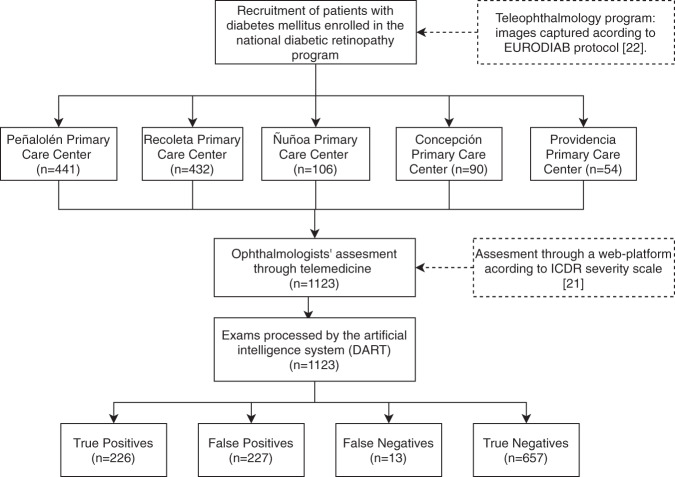
This was an observational study of 1123 diabetic eye exams using a validation protocol designed by the commission of the Chilean Ministry of Health personnel and retina specialists.
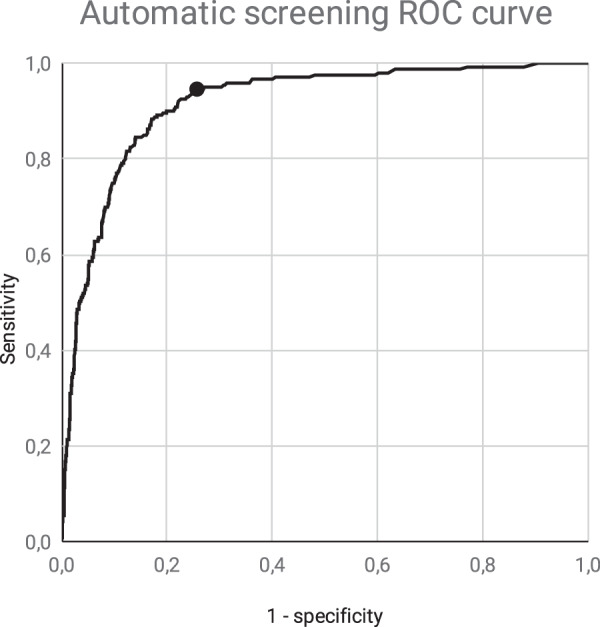
Receiver operating characteristic (ROC) analysis indicated a sensitivity of 94.6% (95% CI: 90.9-96.9%), specificity of 74.3% (95% CI: 73.3-75%), and negative predictive value of 98.1% (95% CI: 96.8-98.9%) for the automated tool at the optimal operating point for DR screening. The area under the ROC curve was 0.915.
The results of this study suggest that DART is a valid tool that could be implemented in a heterogeneous health network such as the Chilean system.
评估一种名为 DART(TeleDx,圣地亚哥,智利)的自动化糖尿病视网膜病变(DR)筛查工具的准确性和有效性,该工具利用人工智能分析眼部眼底照片,以潜在地应用于智利全国 DR 筛查计划。
这是一项使用由智利卫生部人员和视网膜专家委员会设计的验证方案的 1123 例糖尿病眼部检查的观察性研究。
受试者工作特征(ROC)分析表明,该自动化工具在 DR 筛查的最佳工作点具有 94.6%(95%CI:90.9-96.9%)的敏感性、74.3%(95%CI:73.3-75%)的特异性和 98.1%(95%CI:96.8-98.9%)的阴性预测值。ROC 曲线下面积为 0.915。
这项研究的结果表明,DART 是一种有效的工具,可以在智利这样的异构卫生网络中实施。