Kraemer William J, Fragala Maren S, Ratamess Nicholas A
Department of Human Sciences, The Ohio State University, Columbus, OH, USA.
Department of Kinesiology, University of Connecticut, Storrs, CT, USA.
Sports Med Health Sci. 2025 Feb 3;7(5):351-365. doi: 10.1016/j.smhs.2025.01.005. eCollection 2025 Sep.
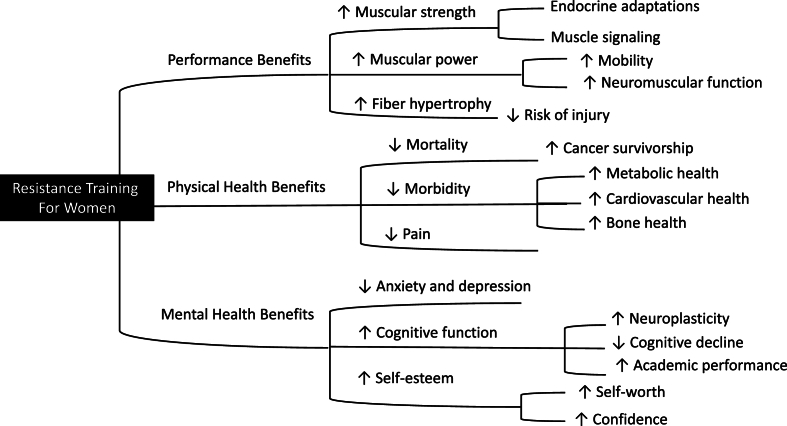
Throughout history, cultural norms and stereotypes have discouraged resistance training in women. Today, as awareness and acceptance of resistance training in women has grown, supported by scientific research and advocacy, more women are achieving health and performance benefits from resistance training. This narrative review discusses the current scientific literature on sexual dimorphisms, the mechanisms underlying health and performance adaptations of resistance training in women, with implications for program design. In general, the physiological adaptations to resistance training in women are mediated largely by the neuroendocrine and immune systems, similar to in men albeit via some distinct predominant pathways involving sex hormones estrogen, testosterone, growth hormone (GH), and insulin-like growth factor- I (IGF-I). As a result, women may have unique adaptations in terms of muscle hypertrophy, substrate utilization, fatiguability, and recovery. Despite subtle physiological differences, women achieve measurable increases in strength, power and athletic performance via engaging in resistance training programs of sufficient frequency, intensity, and duration. Moreover, beyond performance, resistance training has a favorable impact on women's health including metabolic health, body composition, bone health, cardiovascular health, mental health, self-esteem, and body image. Resistance training recommendations for men and women are highly similar and goal-dependent, with some specific caveats that need to be addressed in women. As resistance training has become regarded as a key element of programs for achieving performance and health improvements in women, additional research may further our understanding.
纵观历史,文化规范和刻板印象一直阻碍着女性进行抗阻训练。如今,在科学研究和宣传的支持下,人们对女性抗阻训练的认识和接受度不断提高,越来越多的女性从抗阻训练中获得了健康益处并提升了运动表现。这篇叙述性综述讨论了当前关于性别差异、女性抗阻训练健康与运动表现适应机制的科学文献,并对训练计划设计具有启示意义。一般来说,女性对抗阻训练的生理适应很大程度上由神经内分泌和免疫系统介导,这与男性相似,尽管通过一些涉及性激素雌激素、睾酮、生长激素(GH)和胰岛素样生长因子 -I(IGF-I)的不同主要途径。因此,女性在肌肉肥大、底物利用、疲劳性和恢复方面可能有独特的适应情况。尽管存在细微的生理差异,但通过参与频率、强度和持续时间足够的抗阻训练计划,女性在力量、功率和运动表现方面实现了可测量的提升。此外,除了运动表现,抗阻训练对女性健康有积极影响,包括代谢健康、身体成分、骨骼健康、心血管健康、心理健康、自尊和身体形象。男性和女性的抗阻训练建议高度相似且取决于目标,但女性有一些需要注意的特殊情况。由于抗阻训练已被视为实现女性运动表现和健康改善计划的关键要素,更多的研究可能会加深我们的理解。