Wang Xi, Nursyifa Casia, Aninta Sabhrina Gita, Garcia-Erill Genís, Bertola Laura D, Khan Anubhab, Kuja Josiah, Hanghøj Kristian, Meisner Jonas, Bøggild Thomas, Bradshaw Corey J A, Al-Chaer Amal, Persada Alam Putra, Priyono Dwi Sendi, Tribudi Yuli A, Sudrajad Pita, Gaina Cynthia Dewi, Jiang Yu, Lenstra Johannes A, Cauble-Sims Reagan, Rosen Benjamin D, Hagen Darren E, Heaton Michael P, Smith Timothy P L, Frantz Laurent, Larson Greger, Sinding Mikkel-Holger S, Solihin Dedy Duryadi, Agil Muhammad, Purwantara Bambang, Heller Rasmus
Department of Biology, University of Copenhagen, Copenhagen N, Denmark.
Bioinformatics Research Centre, Department of Molecular Biology and Genetics, Aarhus University, Aarhus, Denmark.
Nat Commun. 2025 Sep 25;16(1):8192. doi: 10.1038/s41467-025-62692-z.
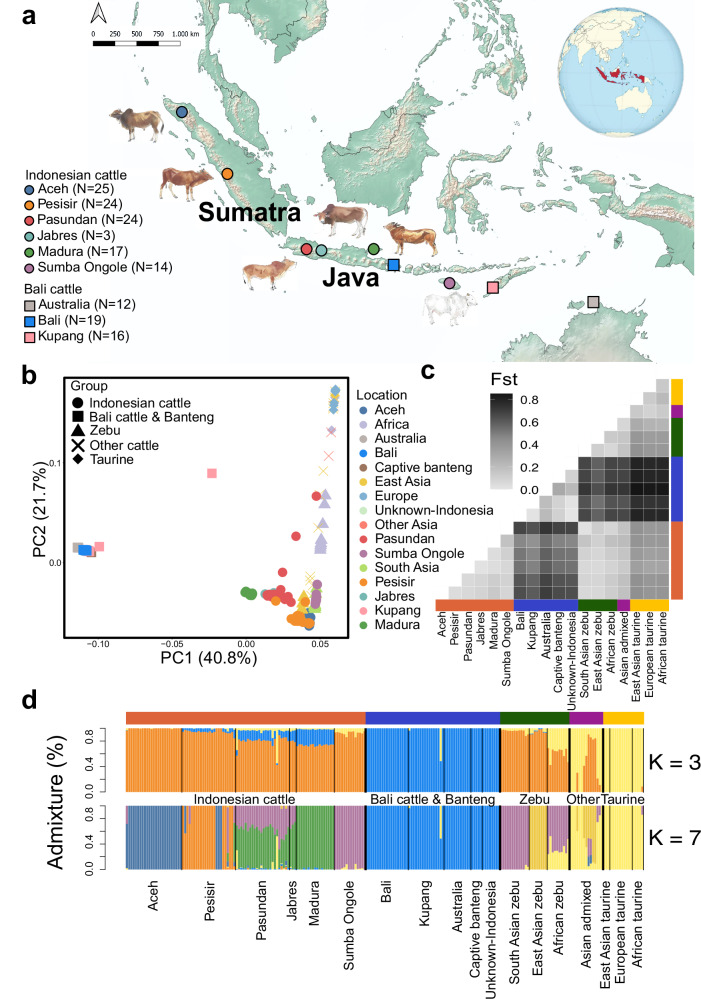
Genetic diversity is a crucial resource in livestock, determining their traits and ability to respond to selection. Indonesian cattle are unique due to their history of admixture involving both zebu (Bos indicus) and banteng (B. javanicus), and may therefore contain novel cattle genetic resources. We generated whole genome sequences from 126 Indonesian cattle, 51 domesticated banteng and three captive banteng. We show that Indonesian cattle have very high genetic diversity, especially the Madura breed due to introgression from banteng and possibly other Bos species, contributing up to 36.6% of the Madura's genome. We find that Indonesian zebu ancestry can be traced to at least three distinct ancestral populations, two of which were introduced more than 1345 years ago from mainland Southeast or eastern Asia. Peaks and valleys in banteng ancestry across the genome in admixed breeds suggest that both negative and positive selection act on introgressed haplotypes. Despite adaptive introgression being mainly breed-specific, we found evidence that some phenotypes, such as coat color, have experienced convergent adaptive introgression. Overall, our results provide insights into the historical movement of cattle in Asia, and showcase the potential for genetic improvement of cattle by identifying ~3.5 million novel SNPs introgressed into Indonesian cattle.
遗传多样性是家畜的一项关键资源,决定着它们的性状以及对选择的响应能力。印度尼西亚牛很独特,因为它们有着瘤牛(Bos indicus)和爪哇野牛(B. javanicus)混合的历史,因此可能蕴藏着全新的牛类遗传资源。我们对126头印度尼西亚牛、51头家养爪哇野牛和3头圈养爪哇野牛进行了全基因组测序。我们发现印度尼西亚牛具有非常高的遗传多样性,尤其是马都拉牛品种,这归因于爪哇野牛以及可能其他牛属物种的基因渗入,其对马都拉牛基因组的贡献高达36.6%。我们发现印度尼西亚瘤牛的祖先可以追溯到至少三个不同的祖先群体,其中两个群体是在1345年多以前从东南亚大陆或东亚引入的。在杂交品种中,全基因组范围内爪哇野牛祖先成分的峰谷表明,正向和负向选择都作用于渗入的单倍型。尽管适应性渗入主要是品种特异性的,但我们发现有证据表明,一些表型,如毛色,经历了趋同适应性渗入。总体而言,我们的研究结果为亚洲牛的历史迁移提供了见解,并通过鉴定渗入到印度尼西亚牛中的约350万个新单核苷酸多态性(SNP),展示了牛遗传改良的潜力。