Pickup J C, Johnston C I, Nakamura S, Uttenthal L O, Hope D B
Biochem J. 1973 Mar;132(3):361-71. doi: 10.1042/bj1320361.
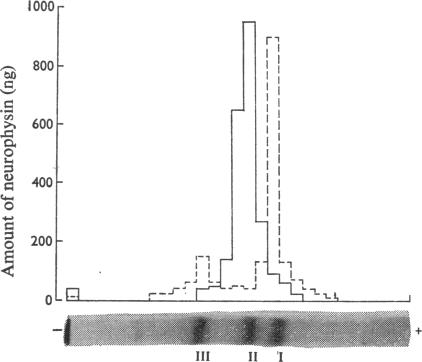
Posterior pituitary lobes from young pigs were fractionated by differential and sucrose-density-gradient centrifugation. The distributions of oxytocin and [8-lysine]-vasopressin were measured by bioassay and the distributions of neurophysin-I and -II by radioimmunoassays specific for each of these two proteins. Most of the hormone and neurophysin applied to the density gradient was localized in particles with the density expected of neurosecretory granules. However, the neurosecretory granules were separated into two bands (D and E). A close statistical correlation between the distributions of [8-lysine]-vasopressin and neurophysin-I, and of oxytocin and neurophysin-II on the gradients, suggested that in vivo porcine neurophysin-I binds [8-lysine]-vasopressin within one population of granules and porcine neurophysin-II binds oxytocin within another type of granule. However, there was no significant separation of oxytocin and vasopressin in fractions D and E. The molar ratios of hormones and neurophysins indicated that there was insufficient of either neurophysin to bind the [8-lysine]-vasopressin in the granule fractions or in the whole gland. Polyacrylamide-gel electrophoresis showed that only bands corresponding in mobility to porcine neurophysins-I, -II and -III were present in large amounts in the whole gland and in the granule fractions. The component with the mobility of neurophysin-III was, however, relatively enriched in whole young glands and granule fractions compared with adult gland extracts. It is suggested that the vasopressin that cannot be assigned to neurophysin-I may occur in (a) vesicles containing vasopressin but no neurophysin, (b) vesicles containing vasopressin and a protein that cannot be quantified by the radioimmunoassays used, such as porcine neurophysin-III, or (c) normal vasopressin-neurophysin granules which have accumulated extra vasopressin. Band E of the gradient was rich in adenosine triphosphatase activity, whereas band D possessed very little of this enzyme.
采用差速离心和蔗糖密度梯度离心法对幼猪的垂体后叶进行分级分离。通过生物测定法测定催产素和[8-赖氨酸]-加压素的分布,通过针对这两种蛋白质各自的放射免疫测定法测定神经垂体素-I和-II的分布。应用于密度梯度的大部分激素和神经垂体素定位于具有神经分泌颗粒预期密度的颗粒中。然而,神经分泌颗粒被分离成两条带(D和E)。梯度上[8-赖氨酸]-加压素与神经垂体素-I以及催产素与神经垂体素-II的分布之间存在密切的统计相关性,这表明在体内猪神经垂体素-I在一类颗粒中结合[8-赖氨酸]-加压素,而猪神经垂体素-II在另一类颗粒中结合催产素。然而,在D和E级分中催产素和加压素没有明显分离。激素与神经垂体素的摩尔比表明,在颗粒级分或整个腺体中,两种神经垂体素中任何一种都不足以结合颗粒中的[8-赖氨酸]-加压素。聚丙烯酰胺凝胶电泳显示,在整个腺体和颗粒级分中大量存在的仅为迁移率与猪神经垂体素-I、-II和-III相对应的条带。然而,与成年腺体提取物相比,具有神经垂体素-III迁移率的组分在整个幼腺体和颗粒级分中相对富集。有人提出,无法归属于神经垂体素-I的加压素可能存在于:(a) 含有加压素但不含神经垂体素的囊泡中;(b) 含有加压素和一种无法通过所用放射免疫测定法定量的蛋白质(如猪神经垂体素-III)的囊泡中;或(c) 积累了额外加压素的正常加压素-神经垂体素颗粒中。梯度的E带富含三磷酸腺苷酶活性,而D带几乎没有这种酶。