Shirahama T, Cohen A S
Am J Pathol. 1973 Oct;73(1):97-114.
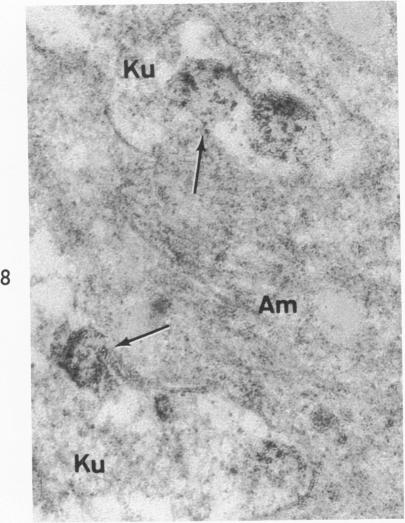
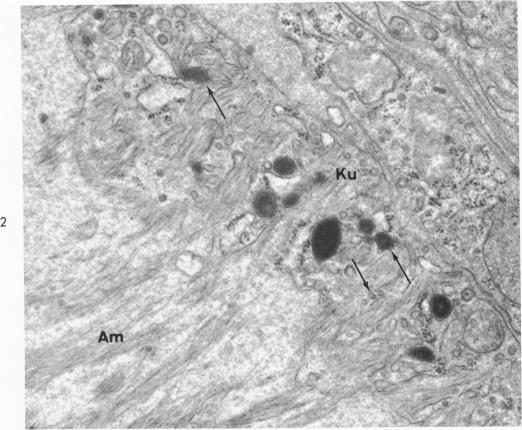
On the basis of recent morpholgic and biochemical studies which suggested the possible involvement of reticuloendothelial (RE) cells and proteolytic enzymes in amyloidogenesis, the present study was undertaken to examine the ultrastructural interrelationship between lysosomes and amyloid fibrils at the sites of very early amyloid deposition. In the spleen, liver and kidney of the experimental mouse model, foci of amyloid deposits were closely associated with the RE cells. The lysosomal enzyme activity, as marked by cytochemical demonstration of acid glycerophosphatase activity, was localized in the primary type lysosomes (as defined by their electron microscopic appearance), in the Golgi complexes, in the small cytoplasmic vesicles and occasionally widespread in the cytoplasm. They showed an intimate relationship to the amyloid fibrils. The findings were interpreted as favoring the hypothesis that the hydrolases play a role in amyloid fibril formation. The enzyme activity was also demonstrated in the secondary type lysosomes which occasionally contained amyloid fibrils that appeared to be phagocytized.
基于近期的形态学和生物化学研究表明网状内皮(RE)细胞和蛋白水解酶可能参与淀粉样变的发生,本研究旨在检查在淀粉样变非常早期沉积部位溶酶体与淀粉样纤维之间的超微结构相互关系。在实验小鼠模型的脾脏、肝脏和肾脏中,淀粉样沉积物灶与RE细胞密切相关。通过酸性甘油磷酸酶活性的细胞化学显示所标记的溶酶体酶活性,定位于初级类型的溶酶体(根据其电子显微镜外观定义)、高尔基体复合物、小细胞质囊泡中,偶尔广泛分布于细胞质中。它们与淀粉样纤维显示出密切关系。这些发现被解释为支持水解酶在淀粉样纤维形成中起作用的假说。在偶尔含有似乎被吞噬的淀粉样纤维的次级类型溶酶体中也证实了酶活性。