Higgins M L, Pooley H M, Shockman G D
J Bacteriol. 1970 Aug;103(2):504-12. doi: 10.1128/jb.103.2.504-512.1970.
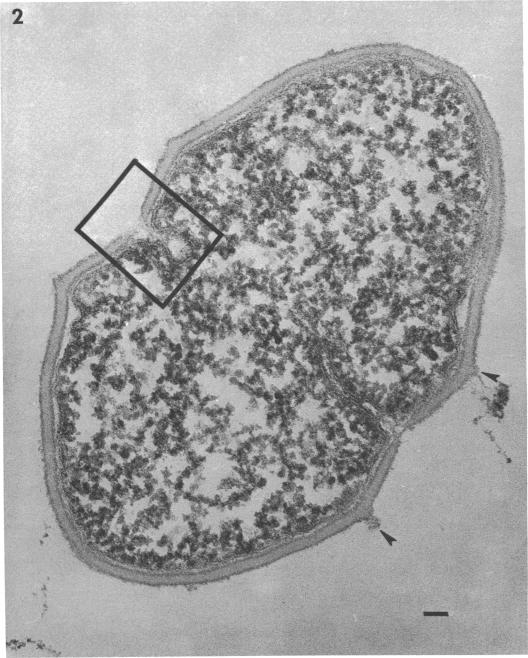
Low concentrations of glutaraldehyde (0.1% or higher) blocked cellular and wall autolysis. The site of autolytic activity was studied by allowing cell autolysis to proceed for very short periods (0 to 15 min) before addition of glutaraldehyde. Electron microscopy of ultrathin sections showed that the primary site of autolytic activity was the leading edge of the nascent cross wall. The base of the cross wall seemed more resistant than the tip. Evidence supporting the involvement of autolysin activity in continued wall extension and in cell separation as well as in the initiation of new sites of wall extension was obtained. In cells exposed for 10 min to chloramphenicol, wall dissolution was very much slower but occurred at the same cross wall site.
低浓度的戊二醛(0.1%或更高)可阻止细胞和细胞壁自溶。通过在添加戊二醛之前让细胞自溶进行非常短的时间(0至15分钟)来研究自溶活性的位点。超薄切片的电子显微镜检查表明,自溶活性的主要位点是新生横壁的前沿。横壁的基部似乎比顶端更具抗性。获得了支持自溶素活性参与细胞壁持续延伸、细胞分离以及新的细胞壁延伸位点起始的证据。在暴露于氯霉素10分钟的细胞中,细胞壁溶解非常缓慢,但发生在相同的横壁位点。