Berkner K L, Sharp P A
Nucleic Acids Res. 1983 Sep 10;11(17):6003-20. doi: 10.1093/nar/11.17.6003.
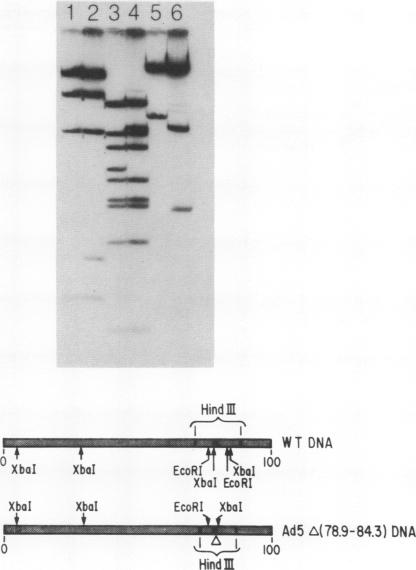
Biologically active fragments of Adenovirus 5 (Ad5) DNA that span the entire genome have been cloned into plasmids. The covalently attached terminal protein was removed and Eco RI linkers added in a fashion that preserves the Ad5 terminal sequences. When plasmids containing overlapping fragments that represent the entire genome are cotransfected onto 293 cells, infectious virus is obtained. Generation of virus depends upon the release of the 0 or 100 mu Ad5 terminus from pBR322 DNA by Eco RI cleavage. During virus production the modified termini of the transfected fragments are corrected exactly to that of wt viral DNA. The above method for preparing adenovirus recombinants has been used to construct a mutant, Ad5 delta (78.9-84.3), lacking most of the non-essential EIII transcriptional unit. This mutant is phenotypically wild type with respect to burst size and kinetics of growth. Surprisingly, it inhibits wt viral growth upon mixed infections of HeLa or 293 cells, apparently at the level of DNA replication.
跨越整个基因组的腺病毒5(Ad5)DNA的生物活性片段已被克隆到质粒中。共价连接的末端蛋白被去除,并且以保留Ad5末端序列的方式添加了Eco RI接头。当将含有代表整个基因组的重叠片段的质粒共转染到293细胞上时,可获得感染性病毒。病毒的产生取决于通过Eco RI切割从pBR322 DNA释放0或100 mu的Ad5末端。在病毒产生过程中,转染片段的修饰末端被精确校正为野生型病毒DNA的末端。上述制备腺病毒重组体的方法已被用于构建一个缺失大部分非必需EIII转录单元的突变体Ad5 delta(78.9 - 84.3)。该突变体在爆发大小和生长动力学方面表现为野生型。令人惊讶的是,在HeLa或293细胞的混合感染中,它明显在DNA复制水平上抑制野生型病毒的生长。