Duffy J L, Khurana E, Susin M, Gomez-Leon G, Churg J
Am J Pathol. 1983 Dec;113(3):279-90.
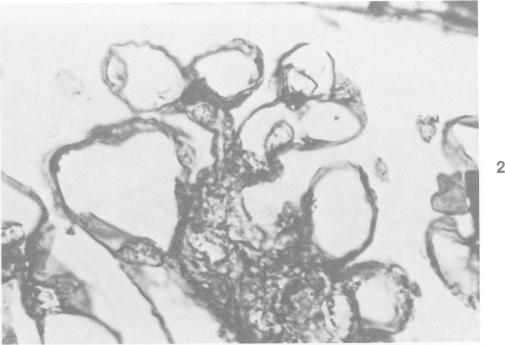
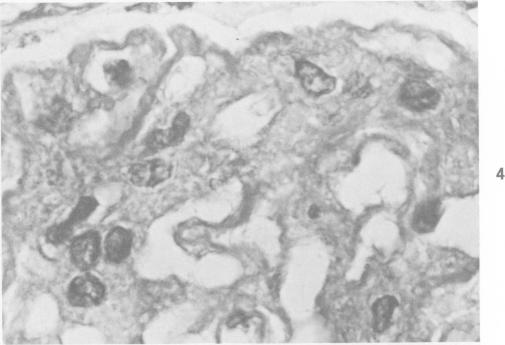
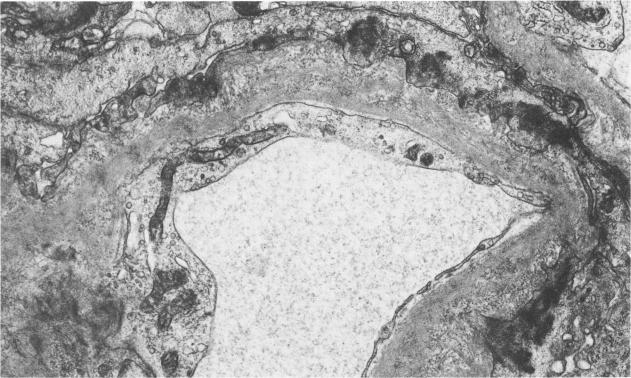
Fibrillary renal deposits and nephritis. The authors have studied 8 patients whose glomeruli contain abundant fibrils in their mesangial matrix and basement membranes. Although the location of these fibrils is very similar to that of amyloid, they are about twice the size of amyloid fibrils, averaging 20 nm in width, and fail to react as amyloid does with special stains. Immunofluorescence-microscopic studies are usually positive with antiserums to IgG, often IgM, and in some cases IgA, and also kappa and lambda light chains, C3, and C4. The fibrils are associated with diffuse mesangial widening and increased mesangial matrix strands. Although peripheral glomerular capillary walls appear to be spared initially, their eventual involvement leads to glomerular capillary collapse and glomerular obsolescence. Crescent formation occurred in 5 cases, focally in 3 and diffusely in 2. Tubular basement membrane involvement was seen in 1 case. These patients exhibit hematuria, and proteinuria, and often hypertension and renal insufficiency. Proteinuria was in the nephrotic range in 3 patients in whom involvement of glomerular capillary basement membranes was extensive. Unless electron microscopy is applied to renal biopsies, these cases may be considered to represent mesangiocapillary or rapidly progressive glomerulonephritis, or amyloidosis. The nature of these fibrils is as yet not determined. It is likely that they have been called "atypical amyloidosis" in the past.
纤维性肾沉积物与肾炎。作者研究了8例患者,其肾小球系膜基质和基底膜中含有丰富的纤维。尽管这些纤维的位置与淀粉样蛋白非常相似,但它们的大小约为淀粉样纤维的两倍,平均宽度为20纳米,并且不像淀粉样蛋白那样对特殊染色有反应。免疫荧光显微镜研究通常对抗IgG血清呈阳性,常为IgM,在某些情况下为IgA,以及κ和λ轻链、C3和C4。这些纤维与弥漫性系膜增宽和系膜基质条索增加有关。尽管肾小球外周毛细血管壁最初似乎未受累,但它们最终的受累会导致肾小球毛细血管塌陷和肾小球荒废。5例出现新月体形成,3例为局灶性,2例为弥漫性。1例可见肾小管基底膜受累。这些患者表现为血尿、蛋白尿,常伴有高血压和肾功能不全。3例肾小球毛细血管基底膜广泛受累的患者蛋白尿处于肾病范围。除非对肾活检进行电子显微镜检查,否则这些病例可能被认为代表系膜毛细血管性或快速进展性肾小球肾炎,或淀粉样变性。这些纤维的性质尚未确定。过去它们可能被称为“非典型淀粉样变性”。