Neel B G, Jhanwar S C, Chaganti R S, Hayward W S
Proc Natl Acad Sci U S A. 1982 Dec;79(24):7842-6. doi: 10.1073/pnas.79.24.7842.
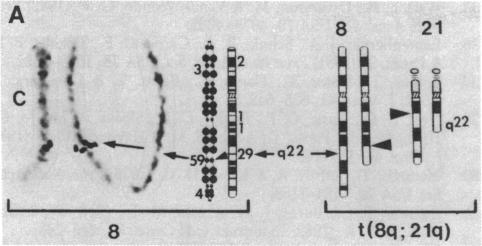
We have used in situ chromosome hybridization techniques to map the human cellular counterparts (c-onc genes) of the transforming genes of two RNA tumor viruses on human meiotic pachytene and somatic metaphase chromosomes. We find that the human c-mos gene is located on chromosome 8 at a position corresponding to band 8q22 on the somatic map. The human c-myc gene is found on chromosome 8 at position 8q24. These regions on the long arm of chromosome 8 have been previously reported to be involved in specific translocations found in the M-2 subset of acute nonlymphoblastic leukemias. Burkitt lymphoma, and other forms of non-Hodgkin lymphoma, and a familial abnormality that predisposes to renal cell carcinoma. These results suggest that translocations of the human c-mos or c-myc genes may be causally related to neoplastic transformation.
我们运用原位染色体杂交技术,将两种RNA肿瘤病毒的转化基因的人类细胞对应物(原癌基因)定位到人类减数分裂粗线期和体细胞中期染色体上。我们发现人类c-mos基因位于8号染色体上,对应于体细胞图谱上的8q22带。人类c-myc基因位于8号染色体的8q24位置。先前已有报道称,8号染色体长臂上的这些区域与急性非淋巴细胞白血病M-2亚群、伯基特淋巴瘤以及其他形式的非霍奇金淋巴瘤中发现的特定易位有关,还与一种易患肾细胞癌的家族性异常有关。这些结果表明,人类c-mos或c-myc基因的易位可能与肿瘤转化存在因果关系。