Tilly K, Murialdo H, Georgopoulos C
Proc Natl Acad Sci U S A. 1981 Mar;78(3):1629-33. doi: 10.1073/pnas.78.3.1629.
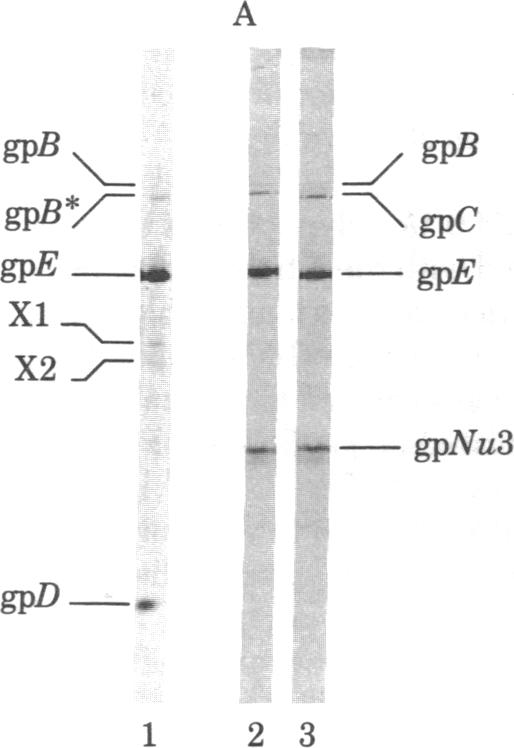
Previous work has uncovered the existence of an Escherichia coli locus, groE, that is essential for bacterial growth, lambda phage and T4 phage head morphogenesis, and T5 phage tail assembly. Our genetic and biochemical analyses of lambda groE+ transducing phages and their deletion and point mutant derivatives show that the groE locus consists of two closely linked genes. One groE gene, groEL, has been shown to encode the synthesis of a 65,000 Mr polypeptide, whereas the second, groES, codes for the synthesis of a 15,000 Mr polypeptide. About half of the groE- bacterial isolates fall into the groES complementation group. GroE mutations in either gene cause similar phenotypes, with respect to lambda phage head morphogenesis and bacterial growth at nonpermissive temperatures.
先前的研究发现了大肠杆菌中的一个基因座groE,它对于细菌生长、λ噬菌体和T4噬菌体头部形态发生以及T5噬菌体尾部组装至关重要。我们对携带groE⁺基因的λ转导噬菌体及其缺失和点突变衍生物进行的遗传和生化分析表明,groE基因座由两个紧密连锁的基因组成。其中一个groE基因groEL已被证明编码一种65,000道尔顿的多肽的合成,而另一个groES基因则编码一种15,000道尔顿的多肽的合成。大约一半的groE⁻细菌分离株属于groES互补组。任一基因中的GroE突变在λ噬菌体头部形态发生和非允许温度下的细菌生长方面都会导致相似的表型。