Russel M, Model P
Proc Natl Acad Sci U S A. 1981 Mar;78(3):1717-21. doi: 10.1073/pnas.78.3.1717.
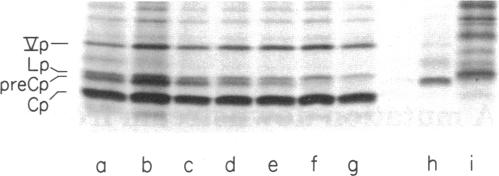
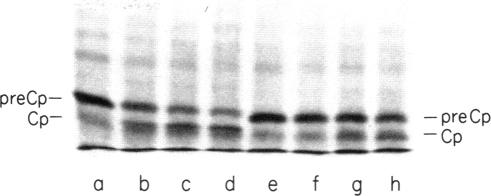
Morphogenesis of filamentous phage includes synthesis of the phage major coat protein in precursor form, its insertion into the host cell plasma membrane, its cleavage to the mature form of the protein, and its assembly there into virions. The M13 mutant am8H1R6 encodes a coat protein in which leucine replaces glutamic acid as residue 2 of the mature protein [Boeke, J. D., Russel, M. & Model, P. (1980) J. Mol. Biol. 144, 103-116]. The coat protein precursor produced by this variant is a poor substrate for the Escherichia coli signal peptidase both in vivo and in vitro. This pre-coat protein, which is eventually processed and assembled into viable phage particles, is associated with the membrane fraction of the infected cell. We conclude that the domain recognized by the signal peptidase extends beyond the signal peptide itself. Furthermore, membrane association and signal peptide cleavage can be separated temporally under conditions that permit membrane insertion, cleavage, and phage assembly.
丝状噬菌体的形态发生包括以前体形式合成噬菌体主要外壳蛋白、将其插入宿主细胞质膜、将其切割成成熟形式的蛋白以及在那里将其组装成病毒粒子。M13突变体am8H1R6编码一种外壳蛋白,其中亮氨酸取代了成熟蛋白第2位的谷氨酸[博克,J.D.,拉塞尔,M.和莫德尔,P.(1980年)《分子生物学杂志》144卷,103 - 116页]。这种变体产生的外壳蛋白前体在体内和体外都是大肠杆菌信号肽酶的不良底物。这种前外壳蛋白最终被加工并组装成有活力的噬菌体颗粒,它与受感染细胞的膜部分相关。我们得出结论,信号肽酶识别的结构域延伸到信号肽本身之外。此外,在允许膜插入、切割和噬菌体组装的条件下,膜结合和信号肽切割可以在时间上分开。