Daniels C J, Bole D G, Quay S C, Oxender D L
Proc Natl Acad Sci U S A. 1981 Sep;78(9):5396-400. doi: 10.1073/pnas.78.9.5396.
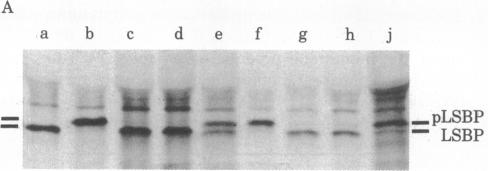
The leucine-specific binding protein of Escherichia coli is a periplasmic protein that is synthesized as a precursor and subsequently is processed during its secretion into the periplasmic space. The processing of both the leucine-specific binding protein and a plasmid-coded beta-lactamase is inhibited by phenethyl alcohol and by the proton ionophore, carbonylcyanide m-chlorophenylhydrazone (CCCP). The levels of CCCP that inhibit processing also produce significant decreases in the membrane potential. Valinomycin, a potassium ionophore, also inhibits processing of the leucine-specific binding protein in spheroplasts. Processing can be restored in CCCP-treated cells and in valinomycin-treated spheroplasts by dilution of the treated cells in fresh medium. These results suggest a role for membrane potential in the secretion of periplasmic proteins. A model is presented which suggests that membrane potential plays a primary role in the proper orientation of the precursor signal sequence within the membrane, thus promoting processing and secretion.
大肠杆菌的亮氨酸特异性结合蛋白是一种周质蛋白,它作为前体被合成,随后在分泌到周质空间的过程中进行加工。亮氨酸特异性结合蛋白和质粒编码的β-内酰胺酶的加工均受到苯乙醇和质子离子载体羰基氰化物间氯苯腙(CCCP)的抑制。抑制加工的CCCP水平也会使膜电位显著降低。缬氨霉素是一种钾离子载体,它也会抑制原生质球中亮氨酸特异性结合蛋白的加工。通过将处理过的细胞稀释在新鲜培养基中,可以使CCCP处理的细胞和缬氨霉素处理的原生质球恢复加工。这些结果表明膜电位在周质蛋白分泌中起作用。本文提出了一个模型,该模型表明膜电位在膜内前体信号序列的正确定向中起主要作用,从而促进加工和分泌。