Stöffler-Meilicke M, Stöffler G, Odom O W, Zinn A, Kramer G, Hardesty B
Proc Natl Acad Sci U S A. 1981 Sep;78(9):5538-42. doi: 10.1073/pnas.78.9.5538.
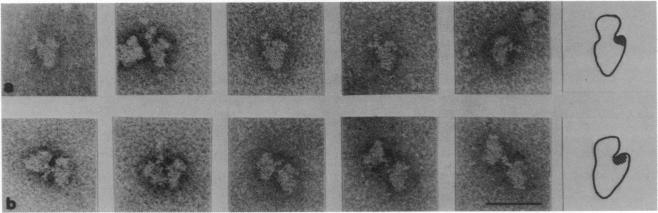
Periodate-oxidized 3' ends of 5S, 23S, and 16S rRNAs from Escherichia coli were allowed to react with fluorescein thiosemicarbazide, then labeled rRNAs were reconstituted into active ribosomal subunits. The fluorescein moiety on each of the rRNAs when reconstituted into ribosomal subunits was accessible to anti-fluorescein IgG as determined by fluorescence quenching and by sucrose gradient centrifugation. The region at which an antibody molecule bond to the labeled ribosomal subunits was determined by immunoelectron microscopy. The 3' end of the 5S RNA was localized on the central protuberance of the 50S subunit. The corresponding region for the 3' end of the 23S RNA was below the stalk on the noninterfacing surface. The 3' end of the 16S RNA was localized to the upper edge of the large lobe of 30S subunits, as reported previously.
将来自大肠杆菌的5S、23S和16S rRNA经高碘酸盐氧化的3'端与荧光素硫代氨基脲反应,然后将标记的rRNA重组到活性核糖体亚基中。通过荧光猝灭和蔗糖梯度离心测定,当rRNA重组到核糖体亚基中时,每个rRNA上的荧光素部分可被抗荧光素IgG识别。通过免疫电子显微镜确定抗体分子与标记核糖体亚基结合的区域。5S RNA的3'端位于50S亚基的中央突起上。23S RNA 3'端的相应区域位于非界面表面茎的下方。如先前报道,16S RNA的3'端位于30S亚基大叶片的上边缘。