Llinás R, Yarom Y
J Physiol. 1981 Jun;315:569-84. doi: 10.1113/jphysiol.1981.sp013764.
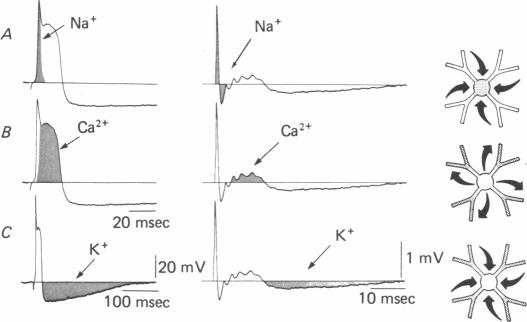
The electrophysiological properties of the high- and low-threshold Ca spikes described in inferior olivary neurones were analysed in detail. 1. During hyperpolarization the low- and high-threshold Ca action potentials can coexist as two distinct spikes, demonstrating non-mutual exclusion. 2. The high-threshold Ca spike shows a lack of refractoriness, is generated remotely from the site of recording and is composed of several all-or-none components, the last two properties suggesting a dendritic origin. 3. Hyperpolarization of the neurones allows the activation of the low-threshold Ca spike, which has activation properties resembling those of the early K conductance described in invertebrates. This low-threshold Ca spike shows refractoriness. 4. The relation between membrane polarization and low-threshold Ca spike is S-shaped. Low-threshold Ca spikes become apparent at -70 mV and have a maximum rate of rise (saturation) at polarization levels more negative than -85 mV. Thus, hyperpolarization removes a voltage-dependent Ca inactivation which is present at normal resting membrane potential (-65 mV). 5. Replacement of extracellular Ca by Ba or addition of tetraethylammonium to the bath corroborates the lack of fast inactivation for the high-threshold Ca spike and the inactivation properties of the low-threshold Ca conductance. It also demonstrates that the duration of the after-depolarization is determined by an interplay between inward Ca current and both voltage-dependent and Ca-dependent K currents. 6. Extracellular recordings from single cells indicate that the Na-dependent spike and the low-threshold Ca action potential are somatic in origin, while the high-threshold Ca spike (after-depolarization) and the hyperpolarization that follows are apparently located in the dendrites. 7. The ionic conductances comprise the main components of the oscillatory behaviour of these cells. The sequence of events leading to oscillation entails initially a low-threshold Ca spike or Na spike, followed by an after-depolarization/after-hyperpolarization sequence and then a post-anodal exaltation product by a rebound low-threshold Ca spike.
对下橄榄核神经元中描述的高阈值和低阈值钙峰的电生理特性进行了详细分析。1. 在超极化期间,低阈值和高阈值钙动作电位可作为两个不同的峰共存,表明不存在相互排斥。2. 高阈值钙峰显示出缺乏不应期,在远离记录部位产生,并且由几个全或无成分组成,后两个特性表明其起源于树突。3. 神经元的超极化允许低阈值钙峰的激活,其激活特性类似于无脊椎动物中描述的早期钾电导。这个低阈值钙峰显示出不应期。4. 膜极化与低阈值钙峰之间的关系呈S形。低阈值钙峰在-70 mV时变得明显,并且在比-85 mV更负的极化水平处具有最大上升速率(饱和)。因此,超极化消除了正常静息膜电位(-65 mV)时存在的电压依赖性钙失活。5. 用钡替代细胞外钙或向浴中添加四乙铵证实了高阈值钙峰缺乏快速失活以及低阈值钙电导的失活特性。它还表明去极化后电位的持续时间由内向钙电流与电压依赖性和钙依赖性钾电流之间的相互作用决定。6. 单细胞的细胞外记录表明,钠依赖性峰和低阈值钙动作电位起源于胞体,而高阈值钙峰(去极化后电位)和随后的超极化显然位于树突中。7. 离子电导构成了这些细胞振荡行为的主要成分。导致振荡的事件序列最初是低阈值钙峰或钠峰,随后是去极化后/超极化后序列,然后是由反弹的低阈值钙峰产生的阳极后增强产物。