Wang N P, Marx J, McNutt M A, Rutledge J C, Gown A M
Department of Pathology, University of Washington, Seattle 98195, USA.
Am J Pathol. 1995 Dec;147(6):1799-810.
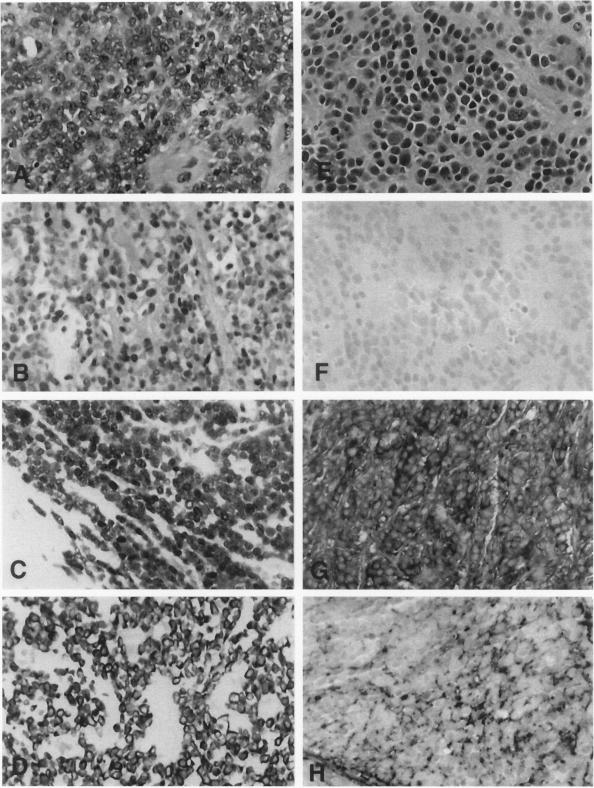
The distinction of rhabdomyosarcoma (RMS) from other small blue round cell tumors of childhood, such as Ewing's sarcoma/peripheral primitive neuroectodermal tumor (pPNET) and neuroblastoma, continues to present a diagnostic challenge to pathologists. The recent recognition of the master role of myogenic regulatory proteins in skeletal muscle commitment and differentiation, and the availability of monoclonal antibodies to two of them (myogenin and MyoD1), has prompted us to test their diagnostic utility in routinely processed, formalin-fixed, and deparaffinized tissue. Preliminary studies had demonstrated that, with the use of heat-induced epitope retrieval techniques, expression of myogenin and MyoD1 could be documented specifically in nuclei of fetal skeletal muscle by the respective antibodies. We performed a retrospective immunohistochemical analysis on 72 cases of small blue round cell tumors, including 33 RMSs, 1 metastatic myogenous Wilms' tumor, 26 Ewing's sarcomas/pPNETs, and 12 neuroblastomas. Nuclear expression of myogenin and MyoD1 were both found in 30/33 non-overlapping cases of RMS, with no significant differences in the sensitivity with respect to histological subtypes, and in 1/1 case of myogenous Wilms' tumor. None of the neuroblastomas or Ewing's sarcomas/pPNETs demonstrated positive nuclear staining with either antibody. However, most of the neuroblastomas, and occasional Ewing's sarcomas/pPNETs, showed variable fibrillary, cytoplasmic immunoreactivity with antibody to MyoD1. We conclude that, with the use of microwave-based epitope retrieval, antibodies to myogenin and MyoD1 are both useful markers for the identification of RMS among other small blue round cell tumors of childhood, but antibodies to myogenin have technical advantages over those to MyoD1, as the latter may cross-react with an unknown cytoplasmic antigen in non-muscle cells and tumors.
横纹肌肉瘤(RMS)与儿童期其他小蓝圆细胞肿瘤,如尤因肉瘤/外周原始神经外胚层肿瘤(pPNET)和神经母细胞瘤的鉴别,仍然给病理学家带来诊断挑战。最近认识到生肌调节蛋白在骨骼肌定向分化中的主导作用,以及针对其中两种蛋白(生肌调节因子和MyoD1)的单克隆抗体的可得性,促使我们测试它们在常规处理的、福尔马林固定和石蜡包埋组织中的诊断效用。初步研究表明,使用热诱导抗原修复技术,生肌调节因子和MyoD1的表达可分别被相应抗体特异性地记录在胎儿骨骼肌细胞核中。我们对72例小蓝圆细胞肿瘤进行了回顾性免疫组化分析,包括33例RMS、1例转移性肌源性威尔姆斯瘤、26例尤因肉瘤/pPNET和12例神经母细胞瘤。在33例不重叠的RMS病例中的30例以及1例肌源性威尔姆斯瘤病例中均发现了生肌调节因子和MyoD1的核表达,在组织学亚型方面敏感性无显著差异。神经母细胞瘤或尤因肉瘤/pPNET均未显示两种抗体的阳性核染色。然而,大多数神经母细胞瘤以及偶尔的尤因肉瘤/pPNET显示与MyoD1抗体有可变的纤维状细胞质免疫反应性。我们得出结论,使用基于微波的抗原修复技术,生肌调节因子和MyoD1抗体都是在儿童期其他小蓝圆细胞肿瘤中识别RMS的有用标志物,但生肌调节因子抗体比MyoD1抗体具有技术优势,因为后者可能与非肌肉细胞和肿瘤中未知的细胞质抗原发生交叉反应。