Khudyakov Y E, Favorov M O, Khudyakova N S, Cong M E, Holloway B P, Padhye N, Lambert S B, Jue D L, Fields H A
Hepatitis Branch, Centers for Disease Control and Prevention, Atlanta, Georgia 30333.
J Virol. 1994 Nov;68(11):7067-74. doi: 10.1128/JVI.68.11.7067-7074.1994.
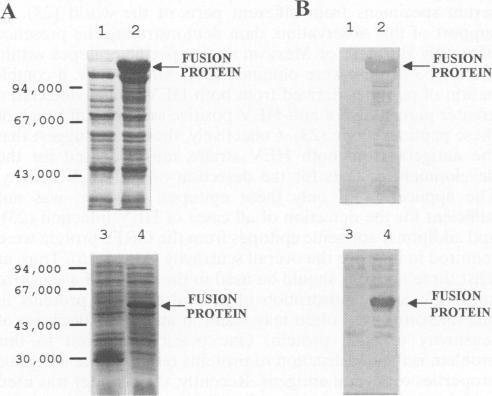
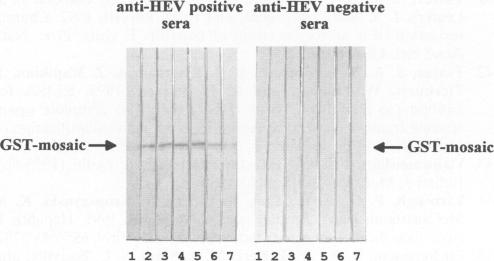
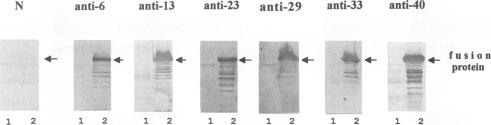
A synthetic gene encoding an artificial polypeptide composed of antigenic epitopes of the hepatitis E virus (HEV) proteins was constructed from short oligodeoxyribonucleotides by using PCR. The polypeptide comprises a mosaic of three antigenically active dominant regions from the protein encoded by open reading frame 2 (ORF2), one antigenically active region from the protein encoded by ORF3 of the Burmese HEV strain, and one antigenically active region from the protein encoded by ORF3 of the Mexican HEV strain. The mosaic protein was expressed in Escherichia coli as a chimera with glutathione S-transferase or beta-galactosidase. Guinea pig sera containing antibodies to the corresponding HEV synthetic peptides were used to demonstrate by Western immunoblot analysis and enzyme immunoassay the presence and accessibility of all HEV-specific antigenic epitopes introduced into the mosaic protein. Both the glutathione S-transferase and beta-galactosidase hybrid proteins were analyzed by using a panel of human anti-HEV-positive and -negative sera. The data obtained strongly indicate a diagnostic potential for the mosaic protein.
通过聚合酶链式反应(PCR),利用短链寡聚脱氧核糖核苷酸构建了一个合成基因,该基因编码由戊型肝炎病毒(HEV)蛋白的抗原表位组成的人工多肽。该多肽包含来自开放阅读框2(ORF2)编码蛋白的三个具有抗原活性的显性区域、来自缅甸HEV株ORF3编码蛋白的一个抗原活性区域以及来自墨西哥HEV株ORF3编码蛋白的一个抗原活性区域的嵌合体。该嵌合蛋白在大肠杆菌中作为与谷胱甘肽S-转移酶或β-半乳糖苷酶的嵌合体表达。通过免疫印迹分析和酶免疫测定,使用含有针对相应HEV合成肽抗体的豚鼠血清来证明引入嵌合蛋白中的所有HEV特异性抗原表位的存在和可及性。使用一组人类抗HEV阳性和阴性血清对谷胱甘肽S-转移酶和β-半乳糖苷酶杂交蛋白进行了分析。所获得的数据强烈表明该嵌合蛋白具有诊断潜力。