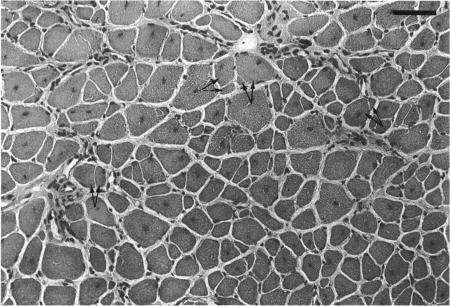
The goals of this study were to evaluate the immunogenicity of myogenic cells (MCs) (1) immediately after implantation into regenerating muscles, and (2) following their maturation under initial immunosuppression. Implanted mouse soleus muscles were evaluated by isometric tension recordings in vitro followed by histological investigations on frozen sections. 2. Implantation of non-histocompatible myoblasts into cryodamaged soleus muscles of CBA/J mice induced immune rejection which caused large and permanent deficits in muscle force: 4-42 weeks postimplantation maximal tetanic tension was 50-60% that of intact or regenerated cryodamaged control muscles without tendency for recovery or histological signs of muscle regeneration. Specific tension (force per unit muscle weight) was also significantly reduced. 3. On frozen sections, only 62 +/- 12% of the total area was desmin-positive, that is, occupied by muscle fibres, versus 90 +/- 4% in regenerated and 92 +/- 3% in intact muscles. Also, the total number of muscle fibre profiles was significantly reduced. 4. Under immune suppression with cyclosporin A (CsA), large muscles developed within 4 weeks. Following CsA withdrawal, muscle weight and force, in addition to desmin-positive areas on cross-sections, gradually declined over several months despite continual regeneration, indicating retarded immune rejection. 5. Initial application of CsA for 8 weeks after implantation, instead of 4 weeks, did not result in better survival of the implants, nor did a higher initial dose of CsA (100 instead of 50 mg kg-1 day-1). Prolonged continuous application of a reduced dose (25 mg kg-1 day-1) did not prevent muscle wasting but caused an additional delay. 6. It is concluded that histoincompatible myoblasts are highly immunogenic and that immune rejection causes large and permanent muscle deficits indicating elimination of host muscle tissue. Initial transient immunosuppression protects the incompatible cells, but after withdrawal, prolonged immune rejection and retarded muscle wasting occur.