Myers R S, Kuzminov A, Stahl F W
Institute of Molecular Biology, University of Oregon, Eugene 97403-1229, USA.
Proc Natl Acad Sci U S A. 1995 Jul 3;92(14):6244-8. doi: 10.1073/pnas.92.14.6244.
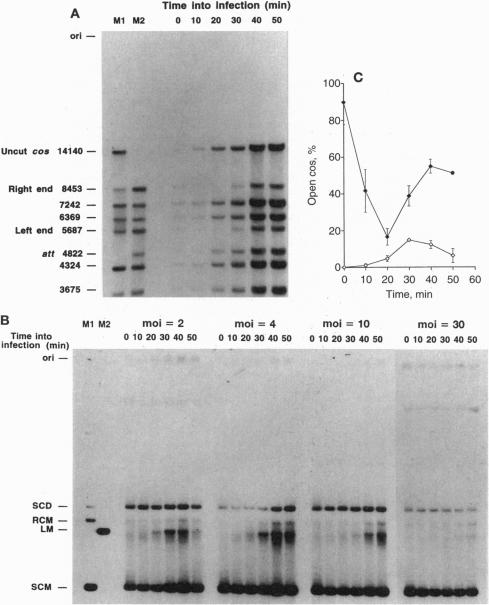
The products of the recB and recC genes are necessary for conjugal recombination and for repair of chromosomal double-chain breaks in Escherichia coli. The recD gene product combines with the RecB and RecC proteins to comprise RecBCD enzyme but is required for neither recombination nor repair. On the contrary, RecBCD enzyme is an exonuclease that inhibits recombination by destroying linear DNA. The RecD ejection model proposes that RecBCD enzyme enters a DNA duplex at a double-chain end and travels destructively until it encounters the recombination hot spot sequence chi. Chi then alters the RecBCD enzyme by weakening the affinity of the RecD subunit for the RecBC heterodimer. With the loss of the RecD subunit, the resulting protein, RecBC(D-), becomes deficient for exonuclease activity and proficient as a recombinagenic helicase. To test the model, genetic crosses between lambda phage were conducted in cells containing chi on a nonhomologous plasmid. Upon delivering a double-chain break to the plasmid, lambda recombined as if the cells had become recD mutants. The ability of chi to alter lambda recombination in trans was reversed by overproducing the RecD subunit. These results indicate that chi can influence a recombination act without directly participating in it.
recB和recC基因的产物对于大肠杆菌中的接合重组和染色体双链断裂的修复是必需的。recD基因产物与RecB和RecC蛋白结合组成RecBCD酶,但对于重组和修复均非必需。相反,RecBCD酶是一种核酸外切酶,通过破坏线性DNA来抑制重组。RecD排出模型提出,RecBCD酶在双链末端进入DNA双链并进行破坏性移动,直到遇到重组热点序列chi。然后,chi通过削弱RecD亚基对RecBC异二聚体的亲和力来改变RecBCD酶。随着RecD亚基的丢失,产生的蛋白RecBC(D-)核酸外切酶活性不足,但作为重组解旋酶活性增强。为了验证该模型,在非同源质粒上含有chi的细胞中进行了λ噬菌体之间的遗传杂交。当给质粒造成双链断裂时,λ噬菌体发生重组,就好像细胞变成了recD突变体一样。通过过量表达RecD亚基可逆转chi在反式作用中改变λ噬菌体重组的能力。这些结果表明,chi可以在不直接参与的情况下影响重组过程。