Gmachl M, Kreil G
Institute of Molecular Biology, Austrian Academy of Sciences, Salzburg.
Proc Natl Acad Sci U S A. 1993 Apr 15;90(8):3569-73. doi: 10.1073/pnas.90.8.3569.
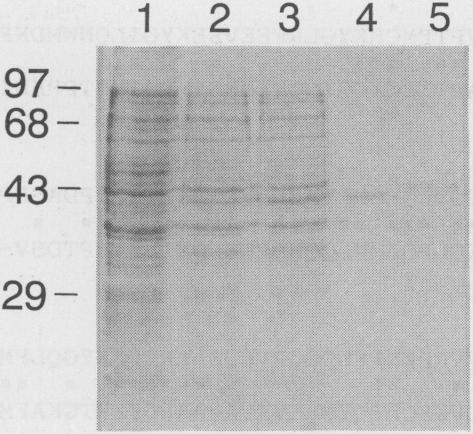
The venom of honeybees, Apis mellifera, contains several biologically active peptides and two enzymes, one of which is a hyaluronidase. By using degenerate oligonucleotides derived from the amino-terminal sequence of this hyaluronidase reported by others, clones encoding the precursor for this enzyme could be isolated from a cDNA library prepared from venom glands of worker bees. The deduced amino acid sequence showed that bee venom hyaluronidase is a polypeptide composed of 349 amino acids containing four cysteines and three potential sites for N-glycosylation. The sequence of the precursor also indicated that the conversion of the pro-enzyme to the end product must involve cleavage of a Thr-Pro bond, a most unusual processing reaction. The mRNA encoding hyaluronidase could also be detected in testes from drones. Expression of the cloned cDNA in Escherichia coli yielded a 41-kDa polypeptide that had hyaluronidase activity. Interestingly, the hyaluronidase from bee venom glands exhibited significant homology to PH-20, a membrane protein of guinea pig sperm involved in sperm-egg adhesion. These structural data support the long-held view that hyaluronidases play a role in fertilization.
蜜蜂(西方蜜蜂)的毒液含有多种生物活性肽和两种酶,其中一种是透明质酸酶。利用从他人报道的这种透明质酸酶的氨基末端序列推导而来的简并寡核苷酸,能够从工蜂毒腺制备的cDNA文库中分离出编码该酶前体的克隆。推导的氨基酸序列表明,蜂毒透明质酸酶是一种由349个氨基酸组成的多肽,含有四个半胱氨酸和三个潜在的N-糖基化位点。前体的序列还表明,酶原转化为终产物必定涉及苏氨酸-脯氨酸键的切割,这是一种非常特殊的加工反应。在雄蜂的睾丸中也能检测到编码透明质酸酶的mRNA。在大肠杆菌中克隆cDNA的表达产生了一种具有透明质酸酶活性的41 kDa多肽。有趣的是,来自蜂毒腺的透明质酸酶与PH-20具有显著的同源性,PH-20是豚鼠精子中参与精卵黏附的一种膜蛋白。这些结构数据支持了长期以来的观点,即透明质酸酶在受精过程中发挥作用。