Lehner T, Brookes R, Panagiotidi C, Tao L, Klavinskis L S, Walker J, Walker P, Ward R, Hussain L, Gearing J H
Division of Immunology, United Medical School, Guy's Hospital, London, United Kingdom.
Proc Natl Acad Sci U S A. 1993 Sep 15;90(18):8638-42. doi: 10.1073/pnas.90.18.8638.
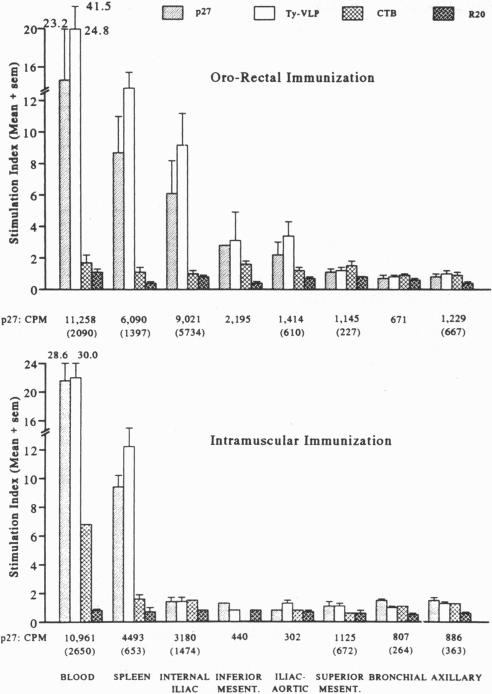
Transmission of human immunodeficiency virus (HIV) in North America and Europe occurs most commonly through the rectal mucosa during homosexual intercourse. The simian immunodeficiency virus (SIV) macaque model has been used to investigate rectal immunization. The vaccine used was a recombinant SIV gag p27 expressed as hybrid Ty virus-like particles (Ty-VLP). Sequential ororectal (OR) mucosal immunization was compared with i.m. immunization. Whereas both routes of immunization induced serum IgA and IgG p27 antibodies, only OR immunization induced rectal secretory IgA antibodies. Specific CD4+ T-cell proliferative responses to stimulation with p27 were found after i.m. immunization only in the blood and spleen, but after OR immunization they were found in the internal iliac and inferior mesenteric lymph nodes in addition to the blood and spleen. T-cell epitope mapping of the proliferative responses of short-term cell lines (STCLs) grown from peripheral blood or lymphoid cells revealed a major epitope within the polypeptide 121-150 after either route of immunization. Two minor T-cell epitopes were found within peptide 41-80 in STCLs from splenic and circulating cells. B-cell epitope mapping of serum or biliary IgA and IgG antibodies revealed two overlapping or adjacent immunodominant epitopes to the T-cell epitopes within the polypeptides 121-170 and 51-90. The results suggest that rectal augmented by oral immunization with a recombinant particulate antigen in nonhuman primates elicits secretory IgA and to a lesser extent IgG responses in the draining lymph nodes and the rectal mucosa, whereas systemic immunization targets predominantly splenic and circulating T- and B-cell responses. These findings may have important implications in the strategy of designing vaccines in prevention of homosexual transmission of HIV infection.
在北美和欧洲,人类免疫缺陷病毒(HIV)最常见的传播途径是在同性恋性交过程中通过直肠黏膜传播。猕猴猿免疫缺陷病毒(SIV)模型已被用于研究直肠免疫。所使用的疫苗是一种表达为杂交Ty病毒样颗粒(Ty-VLP)的重组SIV gag p27。将序贯口直肠(OR)黏膜免疫与肌肉注射免疫进行了比较。虽然两种免疫途径均诱导血清IgA和IgG p27抗体,但只有OR免疫诱导直肠分泌型IgA抗体。仅在肌肉注射免疫后,在血液和脾脏中发现了对p27刺激的特异性CD4+ T细胞增殖反应,但在OR免疫后,除血液和脾脏外,在内髂淋巴结和肠系膜下淋巴结中也发现了这种反应。对从外周血或淋巴细胞培养的短期细胞系(STCL)的增殖反应进行T细胞表位图谱分析发现,无论采用哪种免疫途径,在多肽121-150内都有一个主要表位。在来自脾脏和循环细胞的STCL中的肽41-80内发现了两个次要T细胞表位。对血清或胆汁IgA和IgG抗体进行B细胞表位图谱分析发现,在多肽121-170和51-90内有两个与T细胞表位重叠或相邻的免疫显性表位。结果表明,在非人灵长类动物中,用重组颗粒抗原进行口服免疫增强的直肠免疫在引流淋巴结和直肠黏膜中引发分泌型IgA反应,并在较小程度上引发IgG反应,而全身免疫主要针对脾脏和循环T细胞及B细胞反应。这些发现可能对设计预防HIV感染同性恋传播的疫苗策略具有重要意义。