Lehel C, Olah Z, Jakab G, Anderson W B
Laboratory of Cellular Oncology, National Cancer Institute, National Institutes of Health, Bethesda, MD 20892.
Proc Natl Acad Sci U S A. 1995 Feb 28;92(5):1406-10. doi: 10.1073/pnas.92.5.1406.
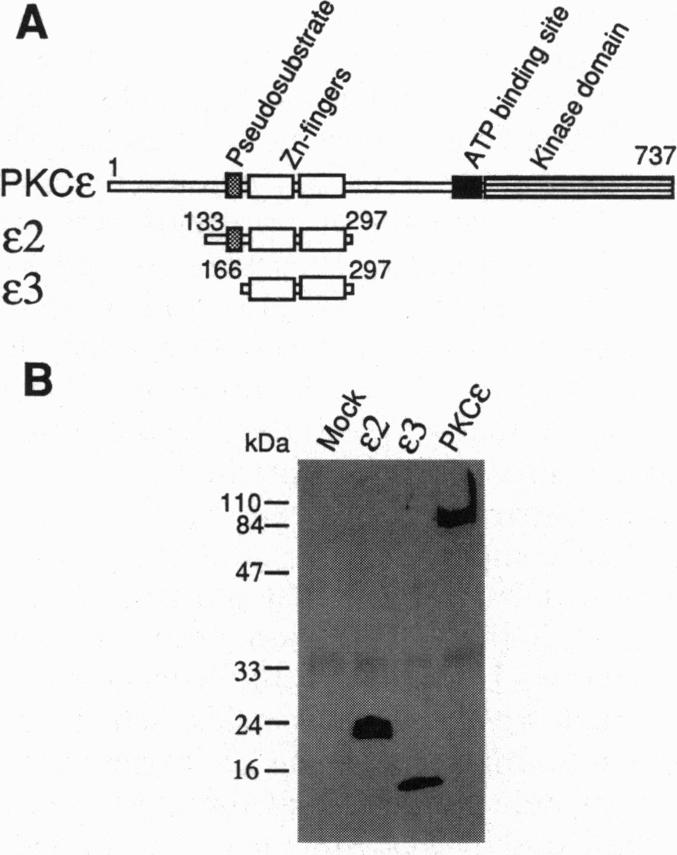
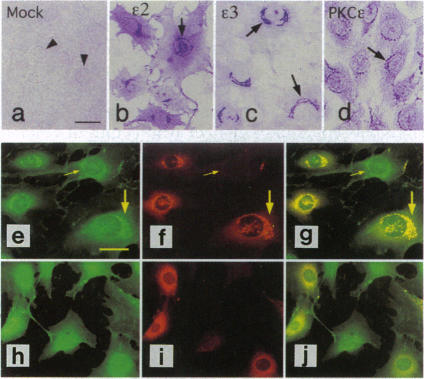
Protein kinase C (PKC) is a multigene family of serine/threonine kinases that are central to many signal transduction pathways. Among the PKC isozymes, only PKC epsilon has been reported to exhibit full oncogenic potential. PKC epsilon also displays unique substrate specificity and intracellular localization. To examine the interrelationship between the biological effects and domain structure of PKC epsilon, NIH 3T3 cells were stably transfected to overexpress different epitope-tagged fragments of PKC epsilon. The overexpressed proteins each contain the epsilon-tag peptide at the C terminus to allow ready detection with an antibody specific for the tag. The holo-PKC epsilon was found to localize with the Golgi network and other compartments, whereas the zinc-finger domain localized exclusively at the Golgi. Golgi-specific glycosaminoglycan sulfation was strongly inhibited in cells overexpressing either holo-PKC epsilon or its zinc-finger domain, while the secretion of sulfated glycosaminoglycans into the medium was impaired in cells expressing the PKC epsilon zinc-finger domain. Thus, these results suggest that PKC epsilon may be involved in specifically regulating Golgi-related processes. Further, the results indicate that PKC epsilon domains other than the kinase domain may also have biological activity and that the zinc-finger domain may function as a subcellular localization signal.
蛋白激酶C(PKC)是丝氨酸/苏氨酸激酶的多基因家族,在许多信号转导途径中起核心作用。在PKC同工酶中,据报道只有PKCε具有完全致癌潜力。PKCε还表现出独特的底物特异性和细胞内定位。为了研究PKCε的生物学效应与结构域结构之间的相互关系,对NIH 3T3细胞进行稳定转染,以过表达PKCε不同的表位标记片段。过表达的蛋白质在C末端均含有ε标签肽,以便用针对该标签的特异性抗体进行检测。发现完整的PKCε定位于高尔基体网络和其他区室,而锌指结构域仅定位于高尔基体。在过表达完整PKCε或其锌指结构域的细胞中,高尔基体特异性糖胺聚糖硫酸化受到强烈抑制,而在表达PKCε锌指结构域的细胞中,硫酸化糖胺聚糖向培养基中的分泌受损。因此,这些结果表明PKCε可能参与特异性调节与高尔基体相关的过程。此外,结果表明激酶结构域以外的PKCε结构域也可能具有生物学活性,并且锌指结构域可能作为亚细胞定位信号发挥作用。