Santoso S, Kalb R, Walka M, Kiefel V, Mueller-Eckhardt C, Newman P J
Institute for Clinical Immunology and Transfusion Medicine, Justus Liebig University, Giessen, Germany.
J Clin Invest. 1993 Nov;92(5):2427-32. doi: 10.1172/JCI116849.
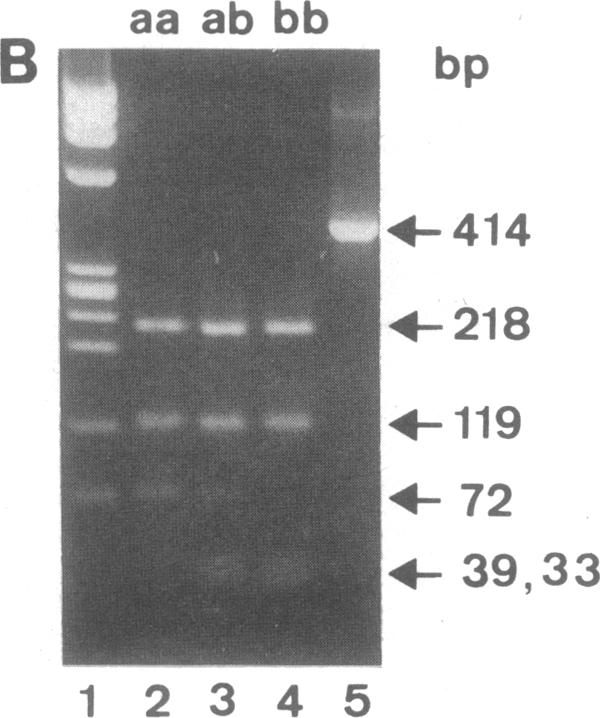
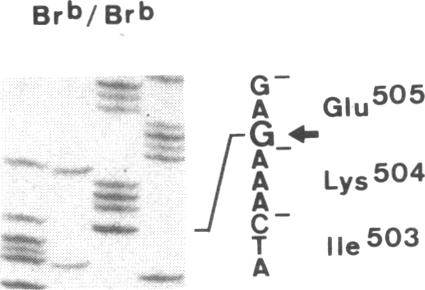
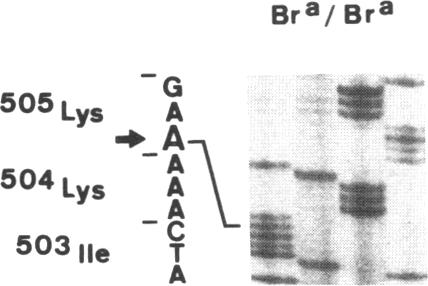
The human GPIa/IIa complex, also known as integrin alpha 2 beta 1, serves as a major receptor for collagen in platelets and other cell types. In addition to its role in platelet adhesion to extracellular matrix, GPIa/IIa is also known to bear the clinically important Br(a) and Brb alloantigenic determinants, which can result in antibody-mediated platelet destruction. Immunochemical studies showed that the Br antigenic epitopes reside solely on the GP Ia subunit and do not depend on sialic acid residues. To define the polymorphism responsible for the Br alloantigen system platelet RNA PCR technique, was used to amplify GPIa mRNA transcripts. Nucleotide sequence analysis of the amplified platelet GPIa cDNA from Br(a/a) and Brb/b individuals revealed a single A<-->G polymorphism at base 1648. MnlI RFLP analysis of cDNA from serologically determined individuals confirmed that this polymorphism segregates with Br phenotype. This single base change results in a substitution of Lys (AAG) in Br(a) to Glu (GAG) in Brb at amino acid residue 505 In spite of the reversal in charge at this position, however, we found no difference in the ability of Bra and Brb homozygous platelets to adhere to collagens types I, III, or V, nor did anti-Bra or anti-Brb alloantibodies interfere with platelet adhesion to any of these fibrillar collagens. The identification of the nucleotide substitution that defines the Bra/Brb alloantigen system will now permit both pre- and postnatal diagnosis for Br phenotype.
人GPIa/IIa复合物,也称为整合素α2β1,是血小板和其他细胞类型中胶原蛋白的主要受体。除了在血小板黏附于细胞外基质中的作用外,GPIa/IIa还已知带有临床上重要的Br(a)和Brb同种异体抗原决定簇,这可能导致抗体介导的血小板破坏。免疫化学研究表明,Br抗原表位仅存在于GP Ia亚基上,不依赖于唾液酸残基。为了确定负责Br同种异体抗原系统的多态性,采用血小板RNA PCR技术扩增GPIa mRNA转录本。对来自Br(a/a)和Brb/b个体的扩增血小板GPIa cDNA进行核苷酸序列分析,发现在第1648位碱基处有一个单一的A<-->G多态性。对血清学确定个体的cDNA进行MnlI RFLP分析证实,这种多态性与Br表型分离。这个单碱基变化导致Br(a)中第505位氨基酸残基的赖氨酸(AAG)被Brb中的谷氨酸(GAG)取代。然而,尽管这个位置电荷发生了反转,我们发现Br(a)和Brb纯合血小板黏附于I型、III型或V型胶原蛋白的能力没有差异,抗Br(a)或抗Brb同种异体抗体也不干扰血小板对任何这些纤维状胶原蛋白的黏附。确定定义Br(a)/Brb同种异体抗原系统的核苷酸取代现在将允许对Br表型进行产前和产后诊断。