Centola M, Carbon J
Department of Biological Sciences, University of California, Santa Barbara 93106.
Mol Cell Biol. 1994 Feb;14(2):1510-9. doi: 10.1128/mcb.14.2.1510-1519.1994.
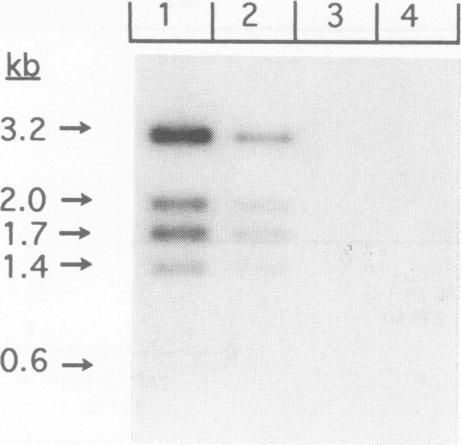
The centromere locus from linkage group VII of Neurospora crassa has been cloned, characterized, and physically mapped. The centromeric DNA is contained within a 450-kb region that is recombination deficient, A+T-rich, and contains repetitive sequences. Repetitive sequences from within this region hybridize to a family of repeats located at or near centromeres in all seven linkage groups of N. crassa. Genomic Southern blots and sequence analysis of these repeats revealed a unique centromere structure containing a divergent family of centromere-specific repeats. The predominantly transitional differences between copies of the centromere-specific sequence repeats and their high A+T content suggest that their divergence was mediated by repeat-induced point (RIP) mutations.
粗糙脉孢菌连锁群VII的着丝粒位点已被克隆、表征并进行了物理图谱绘制。着丝粒DNA包含在一个450 kb的区域内,该区域重组缺陷、富含A+T且含有重复序列。该区域内的重复序列与粗糙脉孢菌所有七个连锁群中位于着丝粒或其附近的一个重复序列家族杂交。对这些重复序列的基因组Southern印迹分析和序列分析揭示了一种独特的着丝粒结构,其中包含一个由着丝粒特异性重复序列组成的不同家族。着丝粒特异性序列重复拷贝之间主要的转换差异及其高A+T含量表明,它们的差异是由重复诱导点突变(RIP)介导的。