Kleuss C, Raw A S, Lee E, Sprang S R, Gilman A G
Department of Pharmacology, University of Texas Southwestern Medical Center, Dallas 75235.
Proc Natl Acad Sci U S A. 1994 Oct 11;91(21):9828-31. doi: 10.1073/pnas.91.21.9828.
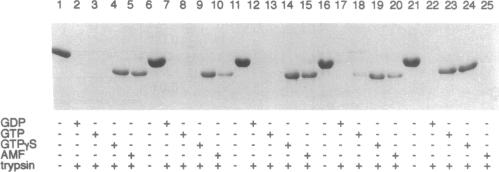
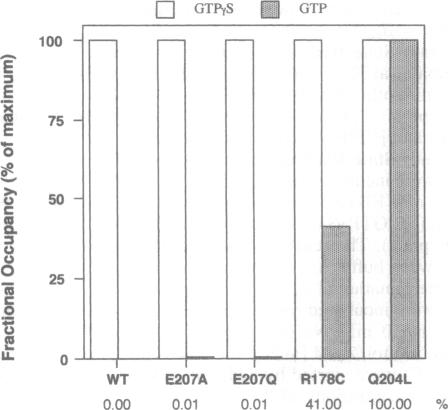
Hydrolysis of GTP by a variety of guanine nucleotide-binding proteins is a crucial step for regulation of these biological switches. Mutations that impair the GTPase activity of certain heterotrimeric signal-transducing G proteins or of p21ras cause tumors in man. A conserved glutamic residue in the alpha subunit of G proteins has been hypothesized to serve as a general base, thereby activating a water molecule for nucleophilic attack on GTP. The results of mutagenesis of this residue (Glu-207) in Gi alpha 1 refute this hypothesis. Based on the structure of the complex of Gi alpha 1 with GDP, Mg2+, and AlF-4, which appears to resemble the transition state for GTP hydrolysis, we believe that Gln-204 of Gi alpha 1, rather than Glu-207, supports catalysis of GTP hydrolysis by stabilization of the transition state.
多种鸟嘌呤核苷酸结合蛋白对GTP的水解作用是调控这些生物开关的关键步骤。某些异源三聚体信号转导G蛋白或p21ras的GTPase活性受损的突变会导致人类肿瘤。G蛋白α亚基中一个保守的谷氨酸残基被推测作为一个通用碱基,从而激活一个水分子对GTP进行亲核攻击。对Giα1中这个残基(Glu-207)进行诱变的结果反驳了这一假设。基于Giα1与GDP、Mg2+和AlF-4的复合物结构,该结构似乎类似于GTP水解的过渡态,我们认为Giα1的Gln-204而非Glu-207通过稳定过渡态来支持GTP水解的催化作用。