Bray D, Lay S
Department of Zoology, University of Cambridge, United Kingdom.
Biophys J. 1994 Apr;66(4):972-7. doi: 10.1016/S0006-3495(94)80878-1.
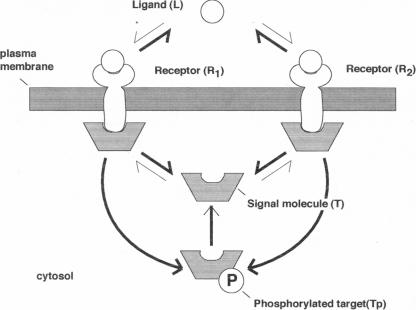
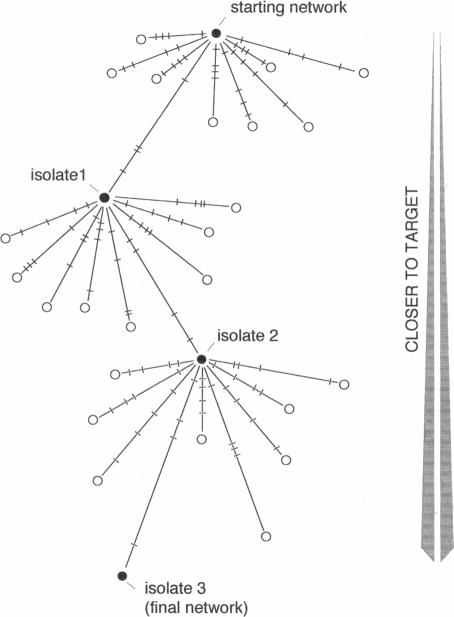
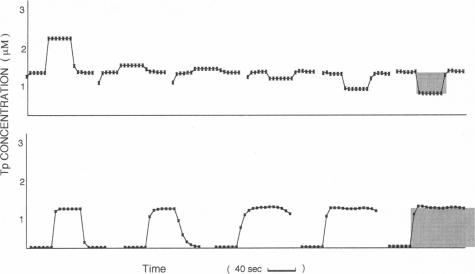
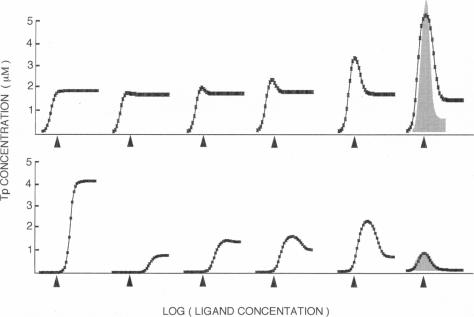
We have trained a computer model of a simple cell-signaling pathway to give specified responses to a pulse of an extracellular ligand. The pathway consists of two initially identical membrane receptors, each of which relays the concentration of the ligand to the level of phosphorylation of an intracellular molecule. Application of random "mutational" changes to the rate constants of the pathway, followed by selection in favor of certain outputs, generates a variety of wave forms and dose-response curves. The phenotypic effect of mutations and the frequency of selection both affect the efficiency with which the pathway achieves its target. When the pathway is trained to give a maximal response at a specific concentration of the stimulating ligand, it gives a consistent pattern of changes in which the two receptors diverge, producing a high-affinity form with excitatory output and a low-affinity form with inhibitory output. We suggest that some high- and low-affinity forms of receptors found in present-day cells might have originated by a similar process.
我们训练了一个简单细胞信号通路的计算机模型,使其对细胞外配体脉冲产生特定反应。该信号通路由两个最初相同的膜受体组成,每个受体将配体浓度传递至细胞内分子的磷酸化水平。对该信号通路的速率常数进行随机“突变”改变,然后选择有利于某些输出的突变,会产生各种波形和剂量反应曲线。突变的表型效应和选择频率都会影响该信号通路实现其目标的效率。当训练该信号通路在特定浓度的刺激配体下产生最大反应时,它会呈现出一种一致的变化模式,其中两个受体发生分化,产生具有兴奋性输出的高亲和力形式和具有抑制性输出的低亲和力形式。我们认为,当今细胞中发现的一些高亲和力和低亲和力形式的受体可能是通过类似的过程产生的。