Hanish J P, Yanowitz J L, de Lange T
Rockefeller University, New York, NY 10021.
Proc Natl Acad Sci U S A. 1994 Sep 13;91(19):8861-5. doi: 10.1073/pnas.91.19.8861.
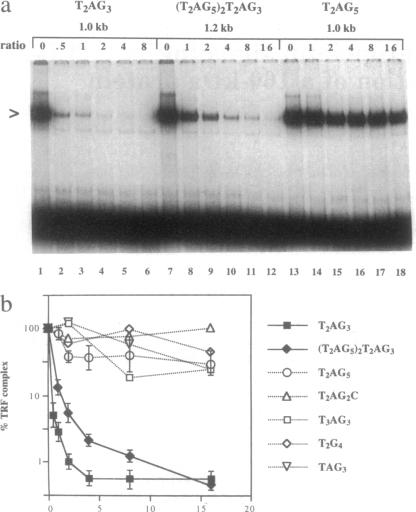
In human cells, transfection of telomeric T2AG3 repeats induces the formation of functional telomeres at previously interstitial sites. We report that telomere formation has stringent sequence requirements. While (T2AG3)n telomere seeds formed telomeres in approximately 70% of the transfected cells, five T2AG3-related heterologous telomeric DNAs seeded new telomeres in < 5% of the transfectants. Telomere formation did not correlate with the ability of human telomerase to elongate telomeric sequences in vitro. Homologous recombination is probably also not involved because a (T2AG3)n telomere seed with nontelomeric DNA at 160-bp intervals formed new telomeres frequently. Instead, the sequence dependence of telomere formation matched the in vitro binding requirements for the mammalian T2AG3 repeat binding factor (TRF). Human TRF failed to bind ineffective heterologous telomere seeds and had a 4-fold lower affinity for (T2AG5)2T2AG3 repeats, which seeded telomeres with reduced frequency. The results suggest that telomere seeds interact with TRF and predict that mammalian artificial chromosomes will require wild-type telomeric repeats at, or near, their termini.
在人类细胞中,端粒T2AG3重复序列的转染可诱导在先前的间质位点形成功能性端粒。我们报告称,端粒形成具有严格的序列要求。虽然(T2AG3)n端粒种子在约70%的转染细胞中形成了端粒,但五种与T2AG3相关的异源端粒DNA在<5%的转染子中播种了新的端粒。端粒形成与人类端粒酶在体外延长端粒序列的能力无关。同源重组可能也不涉及,因为间隔160bp带有非端粒DNA的(T2AG3)n端粒种子经常形成新的端粒。相反,端粒形成的序列依赖性与哺乳动物T2AG3重复结合因子(TRF)的体外结合要求相匹配。人类TRF未能结合无效的异源端粒种子,并且对(T2AG5)2T2AG3重复序列的亲和力低4倍,后者播种端粒的频率降低。结果表明端粒种子与TRF相互作用,并预测哺乳动物人工染色体在其末端或附近将需要野生型端粒重复序列。