Ishiai M, Wada C, Kawasaki Y, Yura T
Institute for Virus Research, Kyoto University, Japan.
Proc Natl Acad Sci U S A. 1994 Apr 26;91(9):3839-43. doi: 10.1073/pnas.91.9.3839.
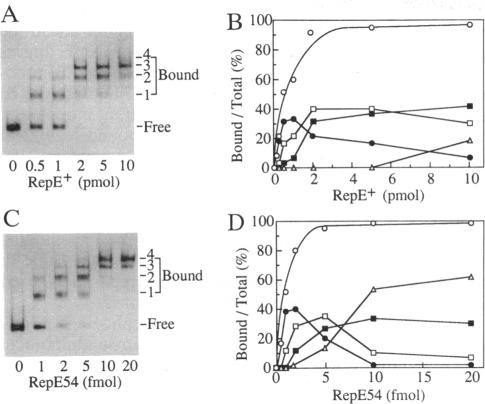
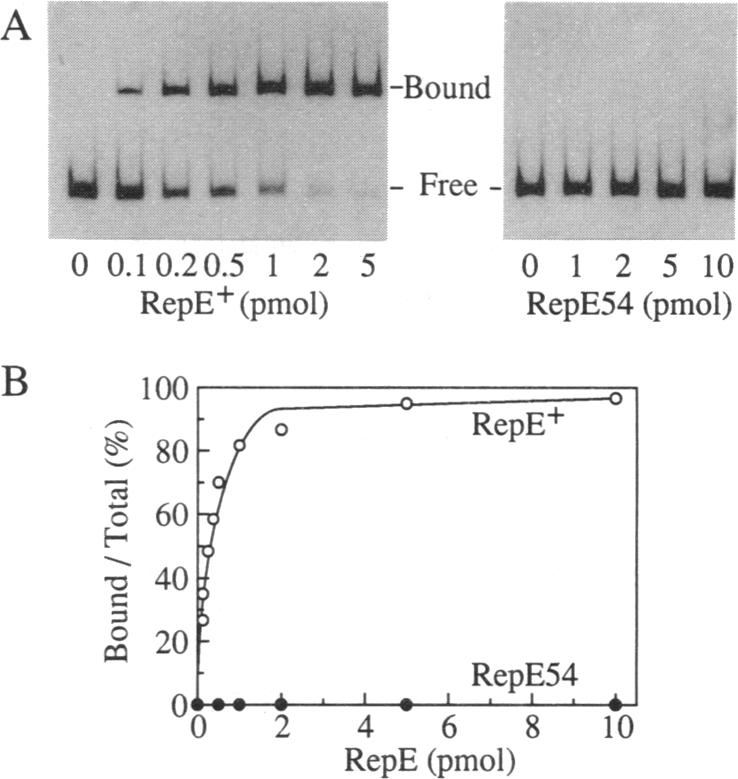
Replication of mini-F plasmid requires the plasmid-encoded RepE initiator protein and several host factors including DnaJ, DnaK, and GrpE, heat shock proteins of Escherichia coli. The RepE protein plays a crucial role in replication and exhibits two major functions: initiation of replication from the origin, ori2, and autogenous repression of repE transcription. One of the mini-F plasmid mutants that can replicate in the dnaJ-defective host produces an altered RepE (RepE54) with a markedly enhanced initiator activity but little or no repressor activity. RepE54 has been purified from cell extracts primarily in monomeric form, unlike the wild-type RepE that is recovered in dimeric form. Gel-retardation assays revealed that RepE54 monomers bind to ori2 (direct repeats) with a very high efficiency but hardly bind to the repE operator (inverted repeat), in accordance with the properties of RepE54 in vivo. Furthermore, the treatment of wild-type RepE dimers with protein denaturants enhanced their binding to ori2 but reduced binding to the operator: RepE dimers were partially converted to monomers, and the ori2 binding activity was uniquely associated with monomers. These results strongly suggest that RepE monomers represent an active form by binding to ori2 to initiate replication, whereas dimers act as an autogenous repressor by binding to the operator. We propose that RepE is structurally and functionally differentiated and that monomerization of RepE dimers, presumably mediated by heat shock protein(s), activates the initiator function and participates in regulation of mini-F DNA replication.
微小F质粒的复制需要质粒编码的RepE起始蛋白和几种宿主因子,包括大肠杆菌的热休克蛋白DnaJ、DnaK和GrpE。RepE蛋白在复制过程中起关键作用,具有两个主要功能:从ori2起始点起始复制,以及对repE转录进行自体抑制。一种能在dnaJ缺陷宿主中复制的微小F质粒突变体产生了一种改变的RepE(RepE54),其起始活性显著增强,但抑制活性很小或没有。与以二聚体形式回收的野生型RepE不同,RepE54主要以单体形式从细胞提取物中纯化得到。凝胶阻滞试验表明,RepE54单体能高效结合ori2(直接重复序列),但几乎不结合repE操纵子(反向重复序列),这与RepE54在体内的特性一致。此外,用蛋白质变性剂处理野生型RepE二聚体可增强其与ori2的结合,但降低与操纵子的结合:RepE二聚体部分转化为单体,且ori2结合活性仅与单体相关。这些结果强烈表明,RepE单体通过结合ori2起始复制而代表一种活性形式,而二聚体则通过结合操纵子起自体抑制作用。我们提出,RepE在结构和功能上存在差异,RepE二聚体的单体化可能由热休克蛋白介导,激活起始功能并参与微小F DNA复制的调控。