
因未接种疫苗导致麻疹疫情。
Measles epidemic from failure to immunize.
作者信息
Dales L G, Kizer K W, Rutherford G W, Pertowski C A, Waterman S H, Woodford G
机构信息
Immunization Branch, California Department of Health Services, Berkeley 94704.
出版信息
West J Med. 1993 Oct;159(4):455-64.
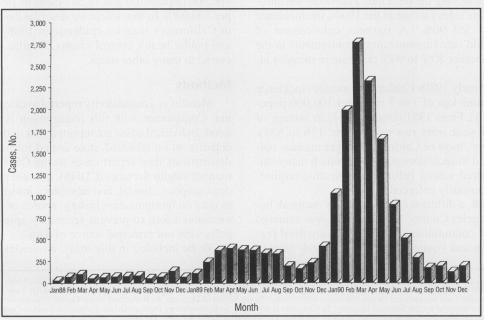
During 1988 through 1990, California experienced its worst measles epidemic in more than a decade, with 16,400 reported cases, 3,390 hospital admissions, and 75 deaths. More than half of the patients were younger than 5 years; the highest incidence was among infants younger than 12 months. The epidemic centered in low-income Hispanic communities in southern and central California. The major cause of the epidemic was low immunization levels among preschool-aged children and young adults. Rates of complications, admission to hospital, and death were surprisingly high. Outbreak control efforts met with indeterminate success. Problems with these efforts included insufficient funding early in the epidemic and disappointing public response to community-based immunization campaigns. The cost of medical care and outbreak control for the epidemic is conservatively estimated at $30.9 million. Unless the level of immunization in preschool-aged children is increased, this type of epidemic will probably recur.
1988年至1990年期间,加利福尼亚州经历了十多年来最严重的麻疹疫情,报告病例达16400例,3390人住院,75人死亡。超过一半的患者年龄小于5岁;发病率最高的是12个月以下的婴儿。疫情集中在加利福尼亚州南部和中部的低收入西班牙裔社区。疫情的主要原因是学龄前儿童和年轻人的免疫接种水平较低。并发症、住院和死亡率出奇地高。疫情控制努力取得了不确定的成功。这些努力存在的问题包括疫情初期资金不足,以及社区免疫运动的公众反应令人失望。据保守估计,此次疫情的医疗护理和疫情控制成本为3090万美元。除非提高学龄前儿童的免疫接种水平,否则这种类型的疫情可能会再次发生。


 Zotero 插件