Hillman R J, Ryait B K, Botcherby M, Taylor-Robinson D
Division of Sexually Transmitted Diseases, Clinical Research Centre, Harrow, Middlesex, UK.
Genitourin Med. 1993 Dec;69(6):450-6. doi: 10.1136/sti.69.6.450.
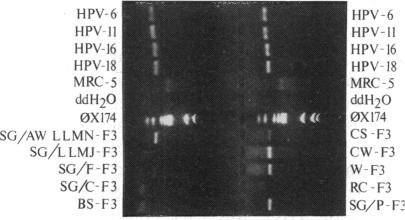
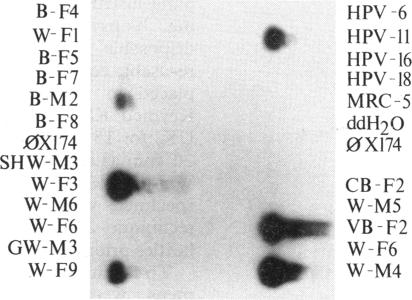
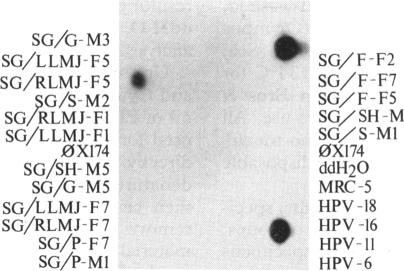
OBJECTIVES--To investigate the relationship between clinical findings and the detection of human papillomavirus (HPV) DNA in a range of anatomical sites in patients with and without anogenital warts. SUBJECTS--Men and women with a clinical diagnosis of anogenital warts, or a current partner with anogenital warts. SETTING--A department of genitourinary medicine in central London. METHODS--The anogenital areas of the patients were thoroughly examined using a colposcope before and after application of acetic acid. Different types of specimens were taken from a variety of anatomical sites. Superficial skin sampling was performed by the application of slides covered with "Superglue" (SG) to clinically normal and abnormal areas of anogenital skin. The presence of human cells in the SG samples was confirmed by detection of the beta-globin gene using the polymerase chain reaction (PCR). HPV DNA was extracted from the specimens and amplified by using consensus primers with the PCR. HPV types 6, 11, 16, 18, 31 and 33 were identified by Southern blotting followed by hybridisation. RESULTS--In women, HPV DNA was detected in 83% of wart biopsies, 29% of cervical biopsies, 36% of cervical scrapes, 25% of urethral loop specimens, 37% of vaginal washes and 33% of rectal swab specimens. In men, HPV DNA was detected in 67% of wart biopsies, 37% of urethral loop specimens and 12% of rectal swab specimens. Of the SG samples containing the beta-globin gene, 49% from women and 50% from men contained HPV DNA. HPV DNA was not detected in buccal scrapes and serum samples from women or men. Of all specimens with detectable HPV DNA, there was evidence of a single HPV type in 41%, multiple types in 48% and undetermined types in 11%. Samples taken from different sites of a patient tended to have HPV types in common. Sexual partners, however, did not consistently have HPV types in common. CONCLUSIONS--HPV DNA was distributed widely in the anogenital area, in warts, acetowhite areas and clinically normal skin. The SG technique was well tolerated by patients and produced results consistent with other findings. Sampling from a single site of the genitalia on one occasion may significantly underestimate the infection rate with HPV. Multifocal infection of the anogenital area with HPV should be taken into consideration when interpreting epidemiological studies and management strategies.
目的——研究有或无肛门生殖器疣患者一系列解剖部位的临床发现与人类乳头瘤病毒(HPV)DNA检测之间的关系。
对象——临床诊断为肛门生殖器疣的男性和女性,或当前有肛门生殖器疣伴侣的人。
地点——伦敦市中心的一家泌尿生殖医学科。
方法——在涂抹醋酸前后,使用阴道镜对患者的肛门生殖器区域进行全面检查。从各种解剖部位采集不同类型的标本。通过将覆盖有“强力胶”(SG)的载玻片应用于肛门生殖器皮肤的临床正常和异常区域进行浅表皮肤采样。通过聚合酶链反应(PCR)检测β-珠蛋白基因来确认SG样本中人类细胞的存在。从标本中提取HPV DNA,并使用PCR通用引物进行扩增。通过Southern印迹杂交鉴定HPV 6、11、16、18、31和33型。
结果——在女性中,83%的疣活检标本、29%的宫颈活检标本、36%的宫颈刮片、25%的尿道环标本、37%的阴道冲洗液和33%的直肠拭子标本中检测到HPV DNA。在男性中,67%的疣活检标本、37%的尿道环标本和12%的直肠拭子标本中检测到HPV DNA。在含有β-珠蛋白基因的SG样本中,49%的女性样本和50%的男性样本含有HPV DNA。在女性或男性的颊部刮片和血清样本中未检测到HPV DNA。在所有可检测到HPV DNA的标本中,41%有单一HPV类型的证据,48%有多种类型,11%类型未确定。从患者不同部位采集的样本往往有共同的HPV类型。然而,性伴侣之间的HPV类型并不总是相同。
结论——HPV DNA广泛分布于肛门生殖器区域,包括疣、醋酸白区域和临床正常皮肤。患者对SG技术耐受性良好,结果与其他发现一致。一次性从生殖器的单个部位采样可能会显著低估HPV感染率。在解释流行病学研究和管理策略时,应考虑肛门生殖器区域HPV的多灶性感染。