Goujon L, Allevato G, Simonin G, Paquereau L, Le Cam A, Clark J, Nielsen J H, Djiane J, Postel-Vinay M C, Edery M
Unité 344, Endocrinologie Moléculaire, Institut National de la Santé et de la Recherche Médicale, Faculté de Médecine Necker, Paris, France.
Proc Natl Acad Sci U S A. 1994 Feb 1;91(3):957-61. doi: 10.1073/pnas.91.3.957.
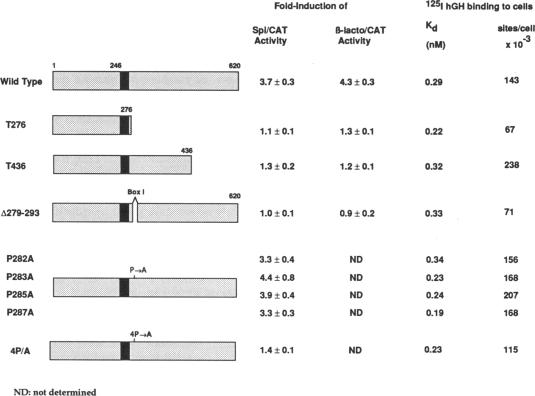
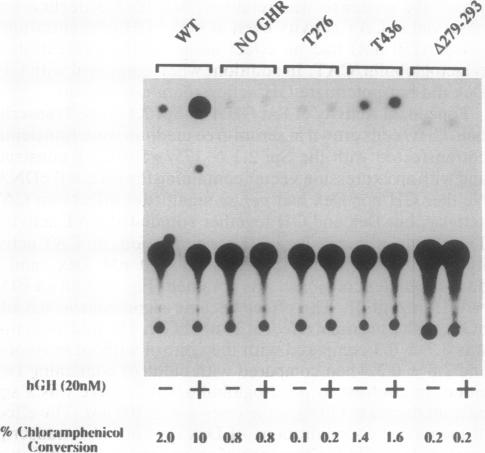
To study structure-function relationships of the growth hormone (GH) receptor (GHR), two functional systems have been developed. CHO cells were transiently cotransfected with the cDNA encoding the full-length rat GHR and with a construct consisting of the 5' flanking region of one of two GH-dependent genes encoding ovine beta-lactoglobulin or serine protease inhibitor 2.1 (Spi 2.1, formerly Spi.1; the corresponding rat gene has recently been redesignated Spin2a) coupled to the bacterial reporter gene encoding chloramphenicol acetyltransferase (CAT). Transfected cells were grown in the absence and presence of human GH and dexamethasone for the Spi 2.1 gene construct. GH was able to activate each promoter (with approximately 4-fold induction of CAT activity) in a dose-dependent manner. For both tests, the maximal effect was observed at 20 nM human GH. These tests have been used to identify functional domains of the GHR. Two truncated (T) GHRs, lacking most or part of the cytoplasmic domain [called T276 (ending at residue 276) and T436 (ending at residue 436)], were unable to stimulate CAT activity. The GHR contains a proline-rich region, called "Box I," conserved in the cytokine/GH/prolactin receptor family. Alanine substitutions for the four prolines of GHR Box I were introduced. Single proline-to-alanine mutations did not affect the functional activity of the GHR. However, modification of the four prolines together or deletion of the Box I (15 amino acids between positions 279 and 293) resulted in the complete absence of GH stimulation. Thus, the proline-rich region, shown to be important for other members of this receptor superfamily, is also critical for GH signal transduction.
为研究生长激素(GH)受体(GHR)的结构-功能关系,已开发出两种功能系统。将编码全长大鼠GHR的cDNA与一种构建体瞬时共转染到CHO细胞中,该构建体由两个GH依赖性基因之一的5'侧翼区域组成,这两个基因分别编码绵羊β-乳球蛋白或丝氨酸蛋白酶抑制剂2.1(Spi 2.1,原称Spi.1;相应的大鼠基因最近重新命名为Spin2a),并与编码氯霉素乙酰转移酶(CAT)的细菌报告基因相连。对于Spi 2.1基因构建体,转染后的细胞在不存在和存在人GH及地塞米松的情况下生长。GH能够以剂量依赖性方式激活每个启动子(CAT活性诱导约4倍)。在这两种测试中,在20 nM人GH时观察到最大效应。这些测试已用于鉴定GHR的功能结构域。两种截短的(T)GHR,缺少大部分或部分胞质结构域[称为T276(在第276位残基处终止)和T436(在第436位残基处终止)],无法刺激CAT活性。GHR包含一个富含脯氨酸的区域,称为“Box I”,在细胞因子/GH/催乳素受体家族中保守。对GHR Box I的四个脯氨酸进行丙氨酸替代。单个脯氨酸到丙氨酸的突变不影响GHR的功能活性。然而,四个脯氨酸一起修饰或Box I缺失(第279和293位之间的15个氨基酸)导致完全没有GH刺激。因此,富含脯氨酸的区域,已证明对该受体超家族的其他成员很重要,对GH信号转导也至关重要。