Hunter C A, Abrams J S, Beaman M H, Remington J S
Department of Medicine, Stanford University School of Medicine, California 94305.
Infect Immun. 1993 Oct;61(10):4038-44. doi: 10.1128/iai.61.10.4038-4044.1993.
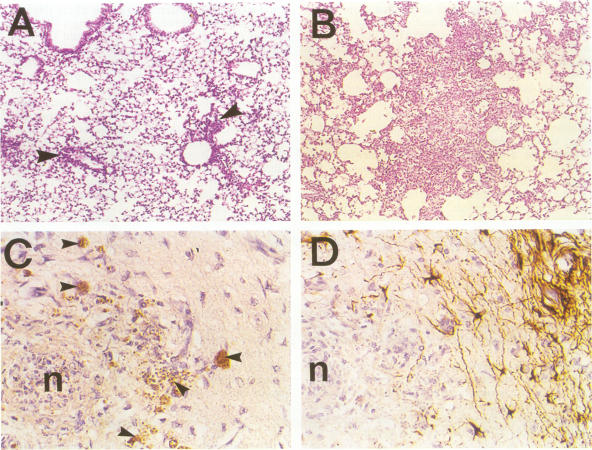
Levels of cytokine mRNA were studied in the central nervous system (CNS) of SCID mice infected with Toxoplasma gondii. This infection led to 100% mortality by day 23 postinfection. Inflammation was observed in the lungs on day 7 and in the heart, liver, and kidneys on days 14 and 18 of infection. In the CNS, necrotic, acellular lesions that contained numerous parasites, accompanied by a localized astrocyte activation, were evident on day 14. Polymerase chain reaction-assisted amplification of RNA revealed that, although transcripts for interleukin-1 alpha (IL-1 alpha) and IL-1 beta were present in the brains of uninfected mice, increased levels of these transcripts were detected on day 7 of infection. Transcripts for macrophage inflammatory protein 1 and transforming growth factor beta were also detected in brains of infected mice at this time point. On days 14 and 18, levels of these transcripts had increased and transcripts for IL-6, IL-10, gamma interferon (IFN-gamma), tumor necrosis factor alpha (TNF-alpha), and granulocyte-macrophage colony-stimulating factor (GM-CSF) were also detected. Transcripts for IL-2 or IL-4 were not detected at any of the time points. Detection of locally produced cytokine transcripts may reflect involvement of the cytokines in the immunopathogenesis of this infection or involvement in mediating antitoxoplasma activity. To assess the possible role of endogenous IFN-gamma, TNF-alpha, IL-10, IL-6, and GM-CSF, cytokine-neutralizing monoclonal antibodies were administered to infected SCID mice. Neutralization of IFN-gamma or TNF-alpha led to earlier mortality than that in controls. In contrast, treatment with antibody to IL-10 and IL-6 increased survival time. Treatment with anti-GM-CSF did not alter the time to death. These results indicate that TNF-alpha and IFN-gamma are both involved in T-cell-independent mechanisms of resistance to T. gondii in SCID mice and that IL-10 and IL-6 may downregulate the immune response to this pathogen.
在感染刚地弓形虫的重症联合免疫缺陷(SCID)小鼠的中枢神经系统(CNS)中研究了细胞因子mRNA的水平。这种感染在感染后第23天导致100%的死亡率。在感染第7天在肺部观察到炎症,在感染第14天和第18天在心脏、肝脏和肾脏观察到炎症。在中枢神经系统中,在第14天可见含有大量寄生虫的坏死性无细胞病变,伴有局部星形胶质细胞活化。聚合酶链反应辅助的RNA扩增显示,虽然白细胞介素-1α(IL-1α)和IL-1β的转录本存在于未感染小鼠的脑中,但在感染第7天检测到这些转录本水平升高。此时在感染小鼠的脑中也检测到巨噬细胞炎性蛋白1和转化生长因子β的转录本。在第14天和第18天,这些转录本的水平升高,并且还检测到IL-6、IL-10、γ干扰素(IFN-γ)、肿瘤坏死因子α(TNF-α)和粒细胞-巨噬细胞集落刺激因子(GM-CSF)的转录本。在任何时间点均未检测到IL-2或IL-4的转录本。局部产生的细胞因子转录本的检测可能反映了细胞因子参与这种感染的免疫发病机制或参与介导抗弓形虫活性。为了评估内源性IFN-γ、TNF-α、IL-10、IL-6和GM-CSF的可能作用,将细胞因子中和单克隆抗体给予感染的SCID小鼠。IFN-γ或TNF-α的中和导致比对照组更早的死亡。相反,用抗IL-10和IL-6抗体治疗可延长存活时间。用抗GM-CSF治疗未改变死亡时间。这些结果表明,TNF-α和IFN-γ均参与SCID小鼠对刚地弓形虫的非T细胞依赖性抵抗机制,并且IL-10和IL-6可能下调对该病原体的免疫反应。