Lee C Z, Lin J H, Chao M, McKnight K, Lai M M
Howard Hughes Medical Institute, University of Southern California School of Medicine, Los Angeles 90033-1054.
J Virol. 1993 Apr;67(4):2221-7. doi: 10.1128/JVI.67.4.2221-2227.1993.
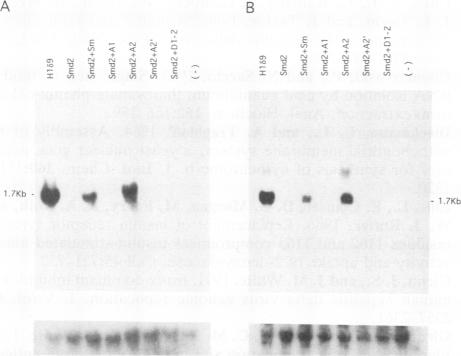
Hepatitis delta antigen (HDAg) is an RNA-binding protein with binding specificity for hepatitis delta virus (HDV) RNA (J. H. Lin, M. F. Chang, S. C. Baker, S. Govindarajan, and M. M. C. Lai, J. Virol. 64:4051-4058, 1990). By amino acid sequence homology search, we have identified within its RNA-binding domain two stretches of an arginine-rich motif (ARM), which is present in many prokaryotic and eukaryotic RNA-binding proteins. The first one is KERQDHRRRKA and the second is EDEKRERRIAG, and they are separated by 29 amino acids. Deletion of either one of these ARM sequences resulted in the total loss of the in vitro RNA-binding activity of HDAg. Thus, HDAg is different from other RNA-binding proteins in that it requires two ARM-like sequences for its RNA-binding activity. Replacement of the spacer sequence between the two ARMs with a shorter stretch of sequence also reduced RNA binding in vitro. Furthermore, site-specific mutations of the basic amino acid residues in both ARMs resulted in the total loss or reduction of RNA-binding activity. The biological significance of the RNA-binding activity was studied by examining the trans-activating activity of the RNA-binding mutants. The plasmids expressing HDAgs with various mutations in the RNA-binding motifs were cotransfected with a replication-defective HDV dimer cDNA construct into COS cells. It was found that all the HDAg mutants which had lost the in vitro RNA-binding activity also lost the ability to complement the defect of HDV RNA replication. We conclude that the trans-activating function of HDAg requires its binding to HDV RNA.
丁型肝炎抗原(HDAg)是一种对丁型肝炎病毒(HDV)RNA具有结合特异性的RNA结合蛋白(J. H. 林、M. F. 张、S. C. 贝克、S. 戈文达拉扬和M. M. C. 赖,《病毒学杂志》64:4051 - 4058,1990年)。通过氨基酸序列同源性搜索,我们在其RNA结合结构域内鉴定出两段富含精氨酸的基序(ARM),这种基序存在于许多原核和真核RNA结合蛋白中。第一段是KERQDHRRRKA,第二段是EDEKRERRIAG,它们相隔29个氨基酸。删除这两个ARM序列中的任何一个都会导致HDAg体外RNA结合活性完全丧失。因此,HDAg与其他RNA结合蛋白不同,它的RNA结合活性需要两个类似ARM的序列。用一段较短的序列替换两个ARM之间的间隔序列也会降低体外RNA结合能力。此外,两个ARM中碱性氨基酸残基的位点特异性突变导致RNA结合活性完全丧失或降低。通过检测RNA结合突变体的反式激活活性来研究RNA结合活性的生物学意义。将表达RNA结合基序中具有各种突变的HDAg的质粒与复制缺陷型HDV二聚体cDNA构建体共转染到COS细胞中。发现所有失去体外RNA结合活性的HDAg突变体也失去了补充HDV RNA复制缺陷的能力。我们得出结论,HDAg的反式激活功能需要其与HDV RNA结合。