Wong K S, Liang E Y, Lam W W, Huang Y N, Kay R
Department of Medicine, Chinese University of Hong Kong, Prince of Wales Hospital, Shatin, Hong Kong.
J Neurol Neurosurg Psychiatry. 1995 Nov;59(5):537-9. doi: 10.1136/jnnp.59.5.537.
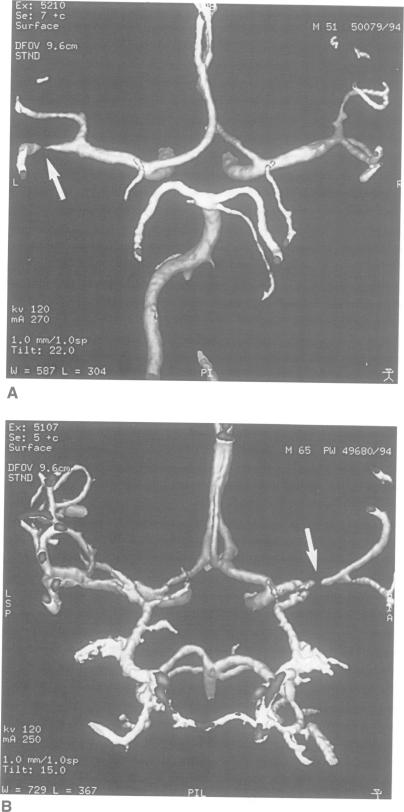
There has been no report on the use of spiral computed tomography angiography (CTA) in the investigation of intracranial cerebral artery stenosis. A prospective pilot study was conducted to investigate the feasibility of CTA in the diagnosis of intracranial occlusive disease and its correlation with transcranial Doppler. With transcranial Doppler, 10 patients with acute ischaemic stroke with middle cerebral artery stenosis or occlusion were identified. There were seven middle cerebral artery stenoses and five middle cerebral artery occlusions. The CTA confirmed all diagnoses by transcranial Doppler except in one patient with middle cerebral artery occlusion in whom the embolus had probably propagated. The results showed that CTA is feasible and potentially useful in the diagnosis of middle cerebral artery occlusive disease. Further studies are required to assess its validity, sensitivity, and specificity in the diagnosis of middle cerebral artery occlusive disease.
目前尚无关于螺旋计算机断层血管造影(CTA)用于颅内脑动脉狭窄研究的报道。我们进行了一项前瞻性试点研究,以探讨CTA在颅内闭塞性疾病诊断中的可行性及其与经颅多普勒的相关性。通过经颅多普勒,确定了10例患有大脑中动脉狭窄或闭塞的急性缺血性卒中患者。其中有7例大脑中动脉狭窄和5例大脑中动脉闭塞。除1例大脑中动脉闭塞患者(其栓子可能已扩散)外,CTA证实了经颅多普勒的所有诊断结果。结果表明,CTA在大脑中动脉闭塞性疾病的诊断中是可行的且可能有用。需要进一步研究以评估其在大脑中动脉闭塞性疾病诊断中的有效性、敏感性和特异性。