Ye J, McCray S K, Clarke S H
Department of Microbiology and Immunology, University of North Carolina at Chapel Hill 27599, USA.
EMBO J. 1996 Apr 1;15(7):1524-33.
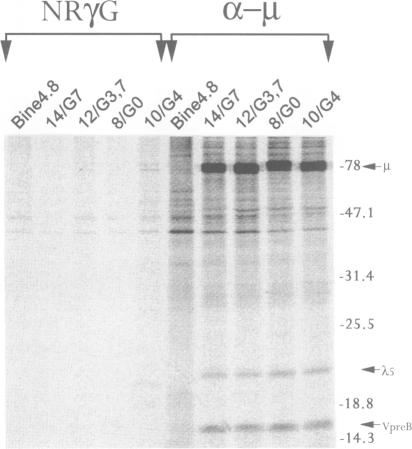
We have demonstrated previously that the majority ( > 90%) of VH12 B cells are absent from the adult peripheral repertoire, and that most that remain have the fourth position at the D-J function (designated 10/G4). We report here that most VH 12-expressing pre-B cells are lost during the transition from the pre-BI to the pre-BII cell stage in normal mice, and that pre-BII cell productive (P) rearrangements ar enriched in 10/G4 CDR3. This coincides with the initial expression of H chain and the generation of the mu/surrogate L chain (SL) receptor. In contrast, there is not enrichment for 10/G4 CDR3 in mu MT mice, and the frequency of P rearrangements is as expected from a random rearrangement mechanism, ruling out a biased rearrangement mechanism unique to VH12. We have also demonstrated that non-10/G4 mu chains can associate with SL and be expressed on the cell surface, suggesting that they are available on the cell surface for selection. Thus, transition of pre-BI to pre-BII cells is dependent on the structure of the VH domain.
我们之前已经证明,成年外周库中不存在大多数(>90%)的VH12 B细胞,并且大多数留存的细胞在D-J功能中处于第四位(命名为10/G4)。我们在此报告,在正常小鼠中,大多数表达VH12的前B细胞在从前B-I细胞阶段向后B-II细胞阶段的转变过程中丢失,并且后B-II细胞的有效(P)重排在10/G4 CDR3中富集。这与重链的初始表达以及μ/替代轻链(SL)受体的产生相吻合。相比之下,在μMT小鼠中,10/G4 CDR3没有富集,并且P重排的频率与随机重排机制所预期的一致,排除了VH12特有的偏向性重排机制。我们还证明,非10/G4 μ链可以与SL结合并在细胞表面表达,这表明它们在细胞表面可供选择。因此,前B-I细胞向后B-II细胞的转变取决于VH结构域的结构。