De Smet C, De Backer O, Faraoni I, Lurquin C, Brasseur F, Boon T
Ludwig Institute for Cancer Research, Brussels Branch, Belgium.
Proc Natl Acad Sci U S A. 1996 Jul 9;93(14):7149-53. doi: 10.1073/pnas.93.14.7149.
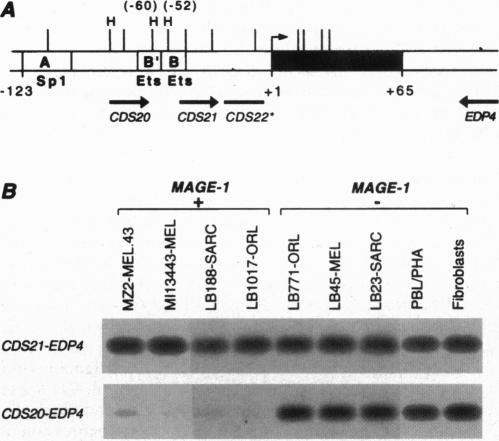
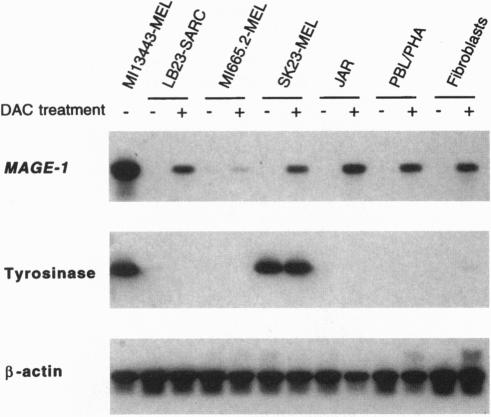
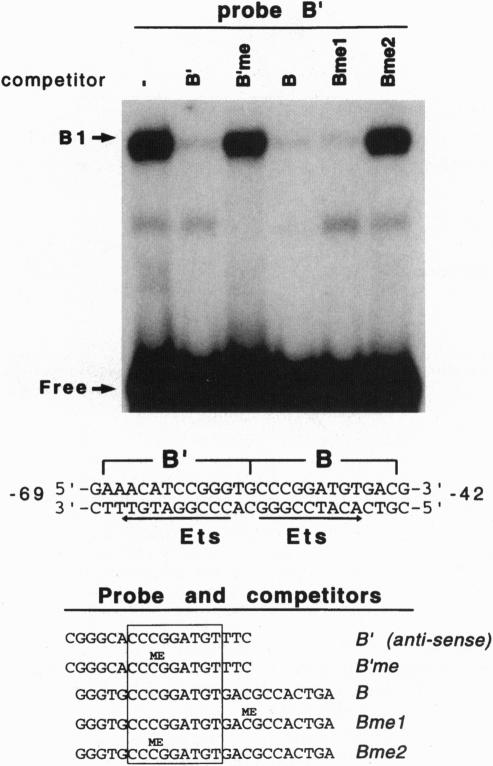
Human gene MAGE-1 encodes tumor-specific antigens that are recognized on melanoma cells by autologous cytolytic T lymphocytes. This gene is expressed in a significant proportion of tumors of various histological types, but not in normal tissues except male germ-line cells. We reported previously that reporter genes driven by the MAGE-1 promoter are active not only in the tumor cell lines that express MAGE-1 but also in those that do not. This suggests that the critical factor causing the activation of MAGE-1 in certain tumors is not the presence of the appropriate transcription factors. The two major MAGE-1 promoter elements have an Ets binding site, which contains a CpG dinucleotide. We report here that these CpG are demethylated in the tumor cell lines that express MAGE-1, and are methylated in those that do not express the gene. Methylation of these CpG inhibits the binding of transcription factors, as seen by mobility shift assay. Treatment with the demethylating agent 5-aza-2'-deoxycytidine activated gene MAGE-1 not only in tumor cell lines but also in primary fibroblasts. Finally, the overall level of CpG methylation was evaluated in 20 different tumor cell lines. It was inversely correlated with the expression of MAGE-1. We conclude that the activation of MAGE-1 in cancer cells is due to the demethylation of the promoter. This appears to be a consequence of a genome-wide demethylation process that occurs in many cancers and is correlated with tumor progression.
人类基因MAGE-1编码肿瘤特异性抗原,这些抗原可被自体溶细胞性T淋巴细胞识别,存在于黑色素瘤细胞上。该基因在多种组织学类型的相当一部分肿瘤中表达,但除男性生殖系细胞外,在正常组织中不表达。我们之前报道过,由MAGE-1启动子驱动的报告基因不仅在表达MAGE-1的肿瘤细胞系中具有活性,在不表达该基因的细胞系中也有活性。这表明,在某些肿瘤中导致MAGE-1激活的关键因素并非合适转录因子的存在。MAGE-1的两个主要启动子元件有一个Ets结合位点,其中包含一个CpG二核苷酸。我们在此报告,这些CpG在表达MAGE-1的肿瘤细胞系中发生去甲基化,而在不表达该基因的细胞系中则发生甲基化。如迁移率变动分析所示,这些CpG的甲基化会抑制转录因子的结合。用去甲基化剂5-氮杂-2'-脱氧胞苷处理,不仅能在肿瘤细胞系中激活MAGE-1基因,还能在原代成纤维细胞中激活该基因。最后,我们评估了20种不同肿瘤细胞系中CpG甲基化的总体水平。其与MAGE-1的表达呈负相关。我们得出结论,癌细胞中MAGE-1的激活是由于启动子的去甲基化。这似乎是许多癌症中发生的全基因组去甲基化过程的结果,且与肿瘤进展相关。