Gannon P F, Newton D T, Belcher J, Pantin C F, Burge P S
Occupational Lung Disease Unit, Birmingham Heartlands Hospital, UK.
Thorax. 1996 May;51(5):484-9. doi: 10.1136/thx.51.5.484.
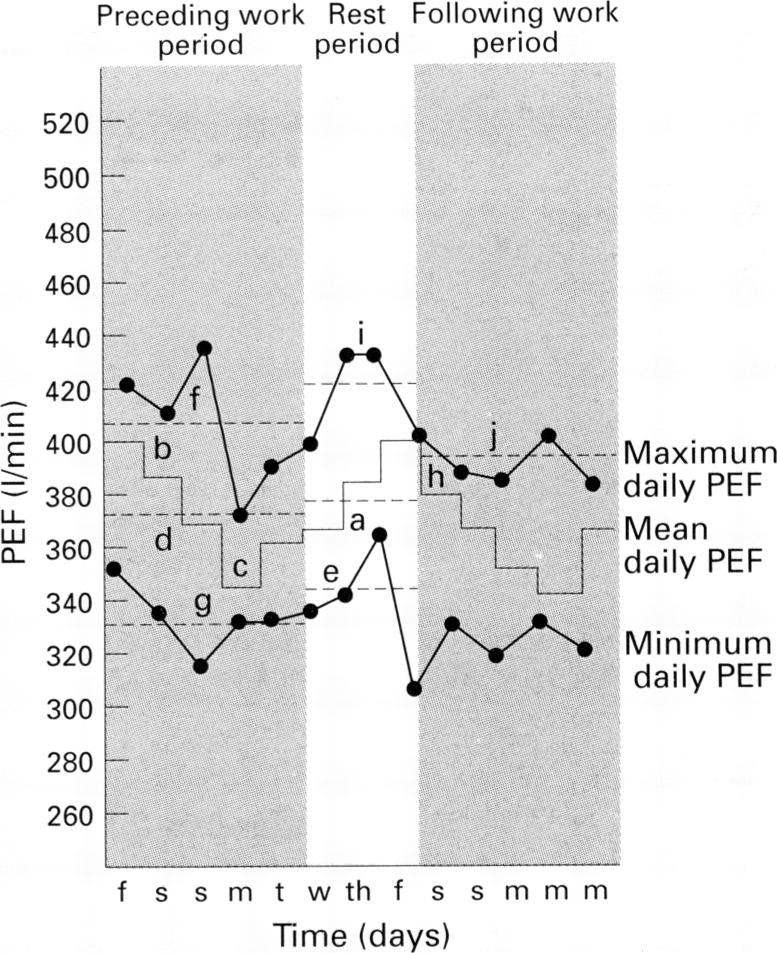
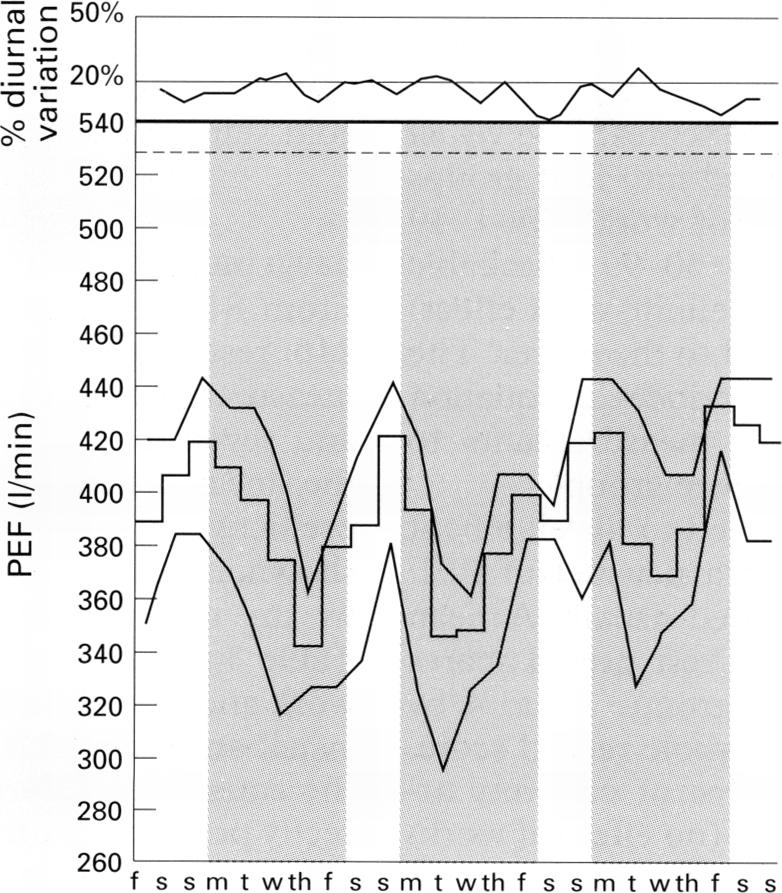
Serial peak expiratory flow (PEF) measurement is usually the most appropriate first step in the confirmation of occupational asthma. Visual assessment of the plotted record is more sensitive and specific than statistical methods so far reported. The use of visual analysis is limited by lack of widespread expertise in the methods. A computer assisted diagnostic aid (OASYS-2) has been developed which is based on a scoring system developed from visual analysis. This removes the requirement for an experienced interpreter and should lead to the more widespread use of the technique.
PEF records were collected from workers attending an occupational lung disease clinic for investigation of suspected occupational asthma and from workers participating in a study of respiratory symptoms in a postal sorting office. PEF records were divided into two development sets and two gold standard sets. The latter consisted of records from workers in which a final diagnosis had been reached by a method other than PEF recording. An experienced observer scored individual work and rest periods for the two development set PEF records; linear discriminant analysis was used to compare measurements taken from development set 1 records with visual scores. Two equations were produced which allowed prediction of scores for individual work or rest periods. The development set 2 was used to determine how these scores should be used to produce a whole record score. The first gold standard set was used to determine the whole record score which best separated those with and without occupational asthma. The second set determined the sensitivity and specificity of the chosen score.
Two hundred and sixty eight PEF records were collected from 169 workers and divided into two development sets (81 and 60 records) and two gold standard sets (60 and 67 records). Linear discriminant analysis produced equations predicting the score for work periods incorporating five indices of PEF change and one for rest periods using seven indices. These equations correctly predicted the score for development set 1 work and rest periods on 61% of occasions (kappa = 0.47). The whole record score for development set 2 records, after weighting for definite or definitely no occupational effect, correlated with the visual score (correlation coefficient 0.86). Comparison with gold standard set 1 identified a cut off which proved to have a sensitivity of 75% and a specificity of 94% for an independent diagnosis of occupational asthma when applied to gold standard set 2.
These results suggest that the sensitivity and specificity of analysing PEF records for occupational asthma using OASYS-2 approaches that of visual analysis, but it should be absolutely reproducible. The performance of OASYS-2 is more specific and approaches the sensitivity of other statistical methods of analysis. The evaluation of a large number of PEF records from workers exposed to different sensitising agents suggests that these results should be robust and should be repeatable in clinical practice.
连续呼气峰值流速(PEF)测量通常是确诊职业性哮喘最恰当的首要步骤。对绘制记录的视觉评估比迄今报道的统计方法更敏感、更具特异性。视觉分析的应用因缺乏该方法的广泛专业知识而受到限制。已开发出一种基于视觉分析所建立评分系统的计算机辅助诊断工具(OASYS - 2)。这消除了对经验丰富的解释人员的需求,并应会使该技术得到更广泛的应用。
收集了到职业性肺病诊所就诊以调查疑似职业性哮喘的工人以及参与邮政分拣办公室呼吸道症状研究的工人的PEF记录。PEF记录被分为两个开发集和两个金标准集。后者由通过PEF记录以外的方法已得出最终诊断的工人的记录组成。一位经验丰富的观察者对两个开发集PEF记录的各个工作和休息时段进行评分;线性判别分析用于比较从开发集1记录中获取的测量值与视觉评分。生成了两个方程,可用于预测各个工作或休息时段的评分。开发集2用于确定应如何使用这些评分来得出整个记录的评分。第一个金标准集用于确定能最佳区分患有和未患有职业性哮喘者的整个记录评分。第二个集确定所选评分的敏感性和特异性。
从169名工人处收集了268份PEF记录,并分为两个开发集(81份和60份记录)和两个金标准集(60份和67份记录)。线性判别分析生成了预测工作时段评分的方程,其中包含五个PEF变化指标,预测休息时段评分的方程使用七个指标。这些方程在61%的情况下正确预测了开发集1工作和休息时段的评分(kappa = 0.47)。在对明确有或明确无职业影响进行加权后,开发集2记录的整个记录评分与视觉评分相关(相关系数0.86)。与金标准集1比较确定了一个临界值,当应用于金标准集2时,该临界值对职业性哮喘独立诊断的敏感性为75%,特异性为94%。
这些结果表明,使用OASYS - 2分析职业性哮喘PEF记录的敏感性和特异性接近视觉分析,但应具有绝对的可重复性。OASYS - 2的性能更具特异性,接近其他统计分析方法的敏感性。对大量接触不同致敏剂工人的PEF记录进行评估表明,这些结果应是可靠的,并且在临床实践中应是可重复的。