Deuschl G, Toro C, Zeffiro T, Massaquoi S, Hallett M
Human Motor Control Section, National Institute of Neurological Disorders and Stroke, National Institutes of Health, Bethesda, MD, USA.
J Neurol Neurosurg Psychiatry. 1996 May;60(5):515-9. doi: 10.1136/jnnp.60.5.515.
To design a test of motor learning using arm movements in normal subjects and patients with cerebellar disease.
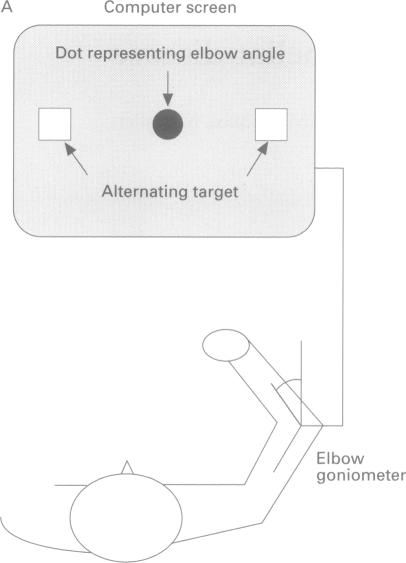
Elbow angle was continuously displayed as a cursor (a dot) on a computer screen, and subjects made ballistic elbow flexion and extension movements to try to move the cursor between two targets on the screen. The relation between the arm movement and its visual feedback was changed, and the subjects reacted by adapting the amplitude of their movements in subsequent trials.
The consecutive errors showed exponential learning curves during adaptation, which were quantified by their steepness. Ten patients with isolated cerebellar or olivopontocerebellar degeneration had less steep learning curves than normal subjects, indicating a failure of adaptation motor learning in cerebellar disease. The results show that this test may be useful for the analysis of motor learning.
设计一项利用正常受试者和小脑疾病患者的手臂运动进行运动学习测试。
肘部角度在电脑屏幕上以光标(一个点)的形式持续显示,受试者进行快速的肘部屈伸运动,试图将光标在屏幕上的两个目标之间移动。手臂运动与其视觉反馈之间的关系发生改变,受试者通过在后续试验中调整其运动幅度做出反应。
在适应过程中,连续误差呈现指数学习曲线,通过曲线斜率进行量化。10例孤立性小脑或橄榄脑桥小脑变性患者的学习曲线斜率低于正常受试者,表明小脑疾病中适应性运动学习失败。结果表明,该测试可能有助于运动学习分析。