Murray A W, Desai A B, Salmon E D
Marine Biological Laboratory, Woods Hole, MA 02453, USA.
Proc Natl Acad Sci U S A. 1996 Oct 29;93(22):12327-32. doi: 10.1073/pnas.93.22.12327.
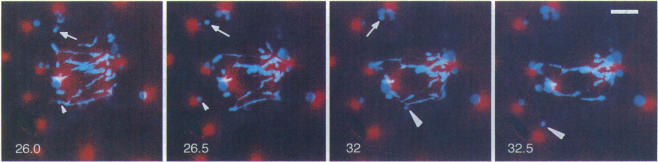
We used digital fluorescence microscopy to make real-time observations of anaphase chromosome movement and changes in microtubule organization in spindles assembled in Xenopus egg extracts. Anaphase chromosome movement in these extracts resembled that seen in living vertebrate cells. During anaphase chromosomes moved toward the spindle poles (anaphase A) and the majority reached positions very close to the spindle poles. The average rate of chromosome to pole movement (2.4 microns/min) was similar to earlier measurements of poleward microtubule flux during metaphase. An increase in pole-to-pole distance (anaphase B) occurred in some spindles. The polyploidy of the spindles we examined allowed us to observe two novel features of mitosis. First, during anaphase, multiple microtubule organizing centers migrated 40 microns or more away from the spindle poles. Second, in telophase, decondensing chromosomes often moved rapidly (7-23 microns/min) away from the spindle poles toward the centers of these asters. This telophase chromosome movement suggests that the surface of decondensing chromosomes, and by extension those of intact nuclei, bear minus-end-directed microtubule motors. Preventing the inactivation of Cdc2/cyclin B complexes by adding nondegradable cyclin B allowed anaphase A to occur at normal velocities, but reduced the ejection of asters from the spindles, blocked chromosome decondensation, and inhibited telophase chromosome movement. In the presence of nondegradable cyclin B, chromosome movement to the poles converted bipolar spindles into pairs of independent monopolar spindles, demonstrating the role of sister chromatid linkage in maintaining spindle bipolarity.
我们使用数字荧光显微镜对非洲爪蟾卵提取物中组装的纺锤体进行实时观察,以研究后期染色体运动和微管组织变化。这些提取物中的后期染色体运动类似于在活的脊椎动物细胞中观察到的运动。在后期,染色体向纺锤体极移动(后期A),大多数染色体到达非常靠近纺锤体极的位置。染色体向极移动的平均速度(2.4微米/分钟)与前期向极微管通量的早期测量结果相似。在一些纺锤体中,极间距离增加(后期B)。我们研究的纺锤体的多倍性使我们能够观察到有丝分裂的两个新特征。首先,在后期,多个微管组织中心从纺锤体极迁移40微米或更远。其次,在末期,解聚的染色体通常快速(7 - 23微米/分钟)从纺锤体极移向这些星状体的中心。这种末期染色体运动表明,解聚染色体的表面,以及完整细胞核的表面,带有负端定向的微管马达。通过添加不可降解的细胞周期蛋白B来防止Cdc2/细胞周期蛋白B复合物失活,使后期A能够以正常速度发生,但减少了星状体从纺锤体中弹出,阻止了染色体解聚,并抑制了末期染色体运动。在存在不可降解的细胞周期蛋白B的情况下,染色体向极的移动将双极纺锤体转变为成对的独立单极纺锤体,证明了姐妹染色单体连接在维持纺锤体双极性中的作用。